This page is also available in / Cette page est également disponible en:
 Français (French)
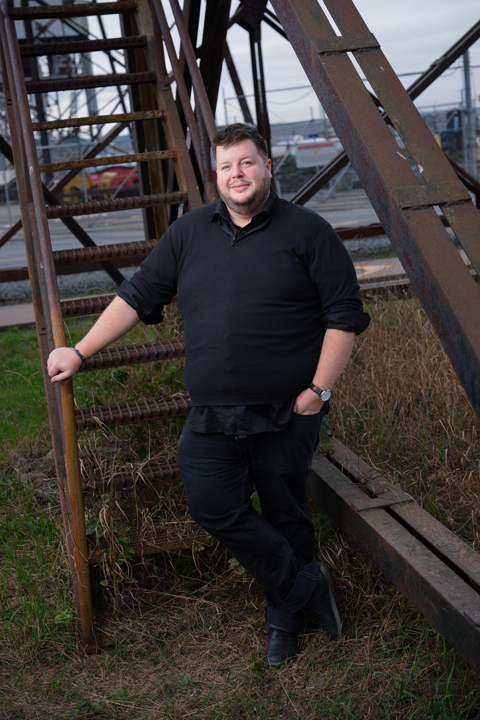
For musicologist, conductor and researcher Jacob Caines, queer musicians may be the key to revitalizing the modern classical music scene.
“Performing arts is in a space where it is, unfortunately, getting squeezed from all sides,” says Caines. There is no need to spell out the numerous obstacles modern classical musicians face. As pianist Charles Rosen famously observed, “the death of classical music is perhaps its oldest continuing tradition.”
“The opportunity for arts institutions to thrive,” says Caines, “is by looking through a queer lens.”
A PhD candidate at Concordia University, and instructor at the Fountain School of Performing Arts at Dalhousie University, Caines takes an eclectic approach to the study of musicology. He is informed not only by music theory and history, but also by social sciences like urban planning, queer theory and archival studies.
It is this wide-ranging blend of interests that gave him the idea for his “living archive.” Six years ago, he created ClassicalQueer as a database of queer musicians within his own community in New Brunswick.
“I was frustrated to hear orchestras say ‘we’d love to represent queer people on stage, but we don’t know any performers…’ This site became a way of saying ‘Here are 15 or 20 people who are working in New Brunswick who are highly skilled professionals, and are also queer or trans.’”
ClassicalQueer’s influence quickly stretched far beyond Caines’s immediate circle. He soon began to notice search hits from locations far and wide.
“Queerness is not spatially bound,” he observes, acknowledging how online spaces have played an essential role in building community among queer people for decades. “Those interspaces between semi-online and semi-real spaces… They’re often the most vibrant spaces where people can live and create.”
It was this focus on vibrant, living spaces that inspired ClassicalQueer. Compared to his archival work, which centred largely around historical figures, his website allowed direct interaction with members of his community. “[It is] very good and useful to gather some core understanding of music history,” he says, “but it’s not how I understand music!” Rather, for Caines, music is about connection.
Caines emphasizes, however, that his archive is not inviting new voices to classical music; rather, he is uplifting the voices that have always been here. “Classical music, despite its outward appearance, has always been hyper-queer,” he says.
“There’s this belief that if we include more diversity in classical music, we’re not going to have room for Beethoven, Bach… It’s not true at all. We can do both, and we might be able to actually see how to keep that music more vibrantly alive by looking through a queer lens. Maybe we should be reaching out to people who think differently.”
This page is also available in / Cette page est également disponible en:
Français (French)