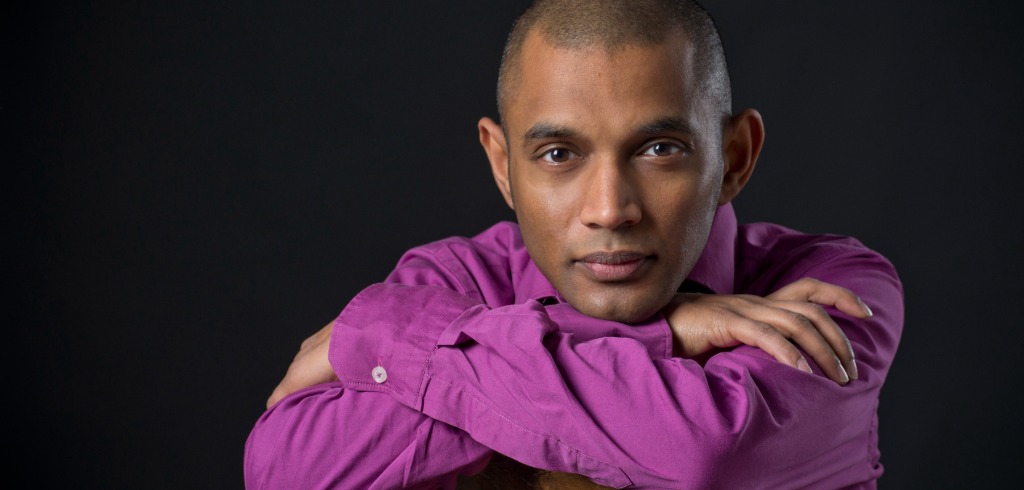

Canadian composer, conductor and pianist Dinuk Wijeratne is well known for his cross-cultural works, which he describes as “East-West.”
“On any given day, I don’t feel either fully Eastern or Western,” says Wijeratne. “Call it a conflict or an identity crisis—but I always think, aren’t I so blessed that I get to try and create a balance for even a few moments in a piece of music?”
Born in Sri Lanka, Wijeratne spent his childhood and adolescent years in Dubai. He studied composition at the Royal Northern College of Music, The Juilliard School, Mannes College and the University of Toronto. Now, the composer resides in Ottawa.
These experiences—and specifically the multiculturalism of Dubai and New York—gave Wijeratne a unique perspective on composing, conducting and performing music. As an example, he speaks about conducting a Mozart symphony: “I can’t help but see it in dialogue with [other musical traditions],” he says. “‘When [Mozart] was writing this, what did Indian classical or Sri Lankan music sound like?’ There is a permanent awareness—it’s just something I can’t avoid.”
A Lovely Tension
Wijeratne often reflects on this dialogue between Western and non-Western musical traditions, particularly the bridge that is improvisation.
“Other cultures made improvisation a very central part of their expression in a way that Western classical music didn’t for a long time, so I think that’s a lovely tension to think about,” he says. “And [improvisation]actually allowed me to connect with Mozart on a deeper level.”
During his school years, the composer spent a lot of time with improvisers, living in an international house and connecting with other world musicians. It was at this time that one of his professors said to him, “Well, you know, Mozart was a great improviser, right?”
Understanding Mozart’s fluency with improvisation suddenly “made everything make sense.” The way a phrase returns, newly decorated, felt akin to the improvisers from other cultures. This fluidity is the lens through which Wijeratne considers much of his work.
For example, he often discourages his students from feeling trapped by tradition. Instead, he asks them to be in constant dialogue: respect it, respond to it and move it forward. “People don’t realize that, when it was happening, it was not tradition—it was just the next innovation,” he says. “Everything must stay in motion.”
Be True to Your Artistic Vision
In addition to his work as a musician, Wijeratne is also a creativity consultant. “What’s fascinating to me after hundreds of hours of speaking to people, 90 percent of it is about artistic voice and the choices that lead to … feeling like [yourself],” he says.
Wijeratne’s artistic voice was built on unconscious absorption first; multiple cultures and musical traditions swirled in his mind before he even thought about drawing upon them. Now, the musician checks in with his voice and vision yearly and ahead of big projects.
“Know who you are, and be true to that. Do not compromise your artistic voice,” he says to emerging artists. “Just get the ball rolling by creating some small, logistically feasible project that is 100 percent authentic.”
Dinuk Wijeratne conducts the Edmonton Symphony Orchestra on April 24 and Saskatoon Symphony Orchestra on May 2.
www.dinukwijeratne.com