
This page is also available in / Cette page est également disponible en:
 Français (French)
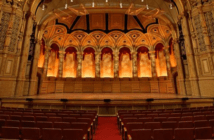
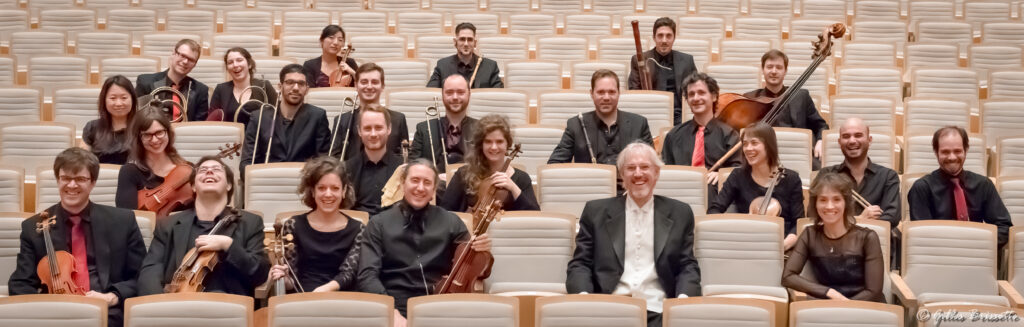
Since its creation in 1989, Ensemble Caprice has lived several lives, crossed continents, and continually reached ever-greater heights, reaching the size of a large orchestra that, depending on the project, is also capable of returning to more intimate dimensions, similar to the spirit of its beginnings. Their 2025-26 season perfectly illustrates these multiple facets, often reflecting their two contrasting venues. Performances at the large Maison symphonique and the intimate Le 9e, a new hall on the Montreal Eaton Centre’s art-deco style restored ninth floor, are symbolic of the musical treasures that this versatile ensemble seeks to bring to light.
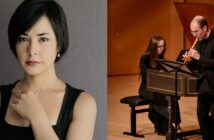
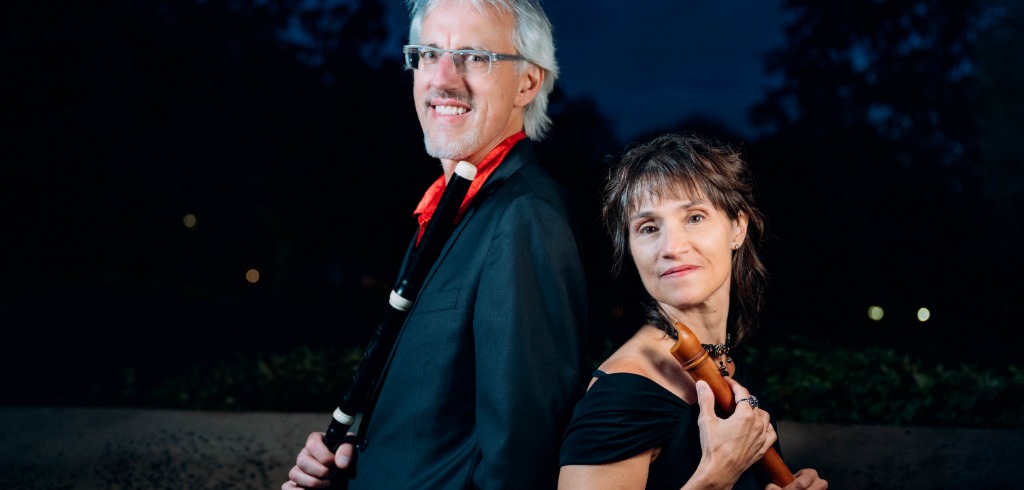
Ensemble Caprice’s continuous evolution hasn’t made founder Matthias Maute forget his primary vocation, which is both to play in the literal sense of the word, and to explore. This exemplary path also owes much to the support of his partner and flutist Sophie Larivière, who joined the ensemble in 1997 and brought her own cultural contribution.
Caprice’s Ambition

“I’m often the public face of the ensemble,” says Maute. “I introduce myself on stage, when I conduct, and so on. But an organization like Ensemble Caprice succeeds mainly thanks to what happens behind the scenes: commitment, efficiency, competence, and collective intelligence. We’re one of the rare few with the two of us as an administrative team, and also together on stage. We started as a chamber music ensemble and we now tour productions like Beethoven’s Ninth Symphony. We’ve been able to grow as opportunities presented themselves. That’s a source of great pride for me.”
Maute formed Caprice in his home country of Germany as a recorder-and-viola-da-gamba duo. Larivière’s arrival sparked the ensemble’s first transformation and fuelled a cycle of growth. “In 1997, we were two flutists, so the repertoire had to change,” she notes. “Along with our own research, came our desire to expand—not only in numbers, but also in repertoire. [We] continued to offer occasional solo programs. This way, we had sufficient resources and together we saw that we could collaborate artistically and musically. We were able to have visions and desires, and to put them into practice.”
By moving to Quebec in 1999, Maute transformed Ensemble Caprice into a Canadian ensemble. But it still had to consolidate its financial profile. The duo took advantage of a rare opportunity to no longer rely exclusively on grants. “In 2013, we really experienced a philanthropic shift. We followed what the government was proposing and moved towards private funding. That gave us even more musical horizons at that time,” says Larivière. Maute adds: “It would never have been possible in Germany, where there is a different system of support and resources. Here, Mécénat Musica allowed us to raise a perpetual endowment fund. We were lucky to arrive at the right time to make the transition from chamber orchestra to orchestra, while continuing to perform repertoire for smaller ensembles. Quebec is truly unique in the global cultural landscape.”
Now, Maute has only one desire: to give back as much as possible to the people here. Thus, Caprice has developed a variety of programs such as mini-health concerts and ClassiqueInclusif, as well as concert ideas that are deliberately out of the ordinary.
Vivaldi on Fire
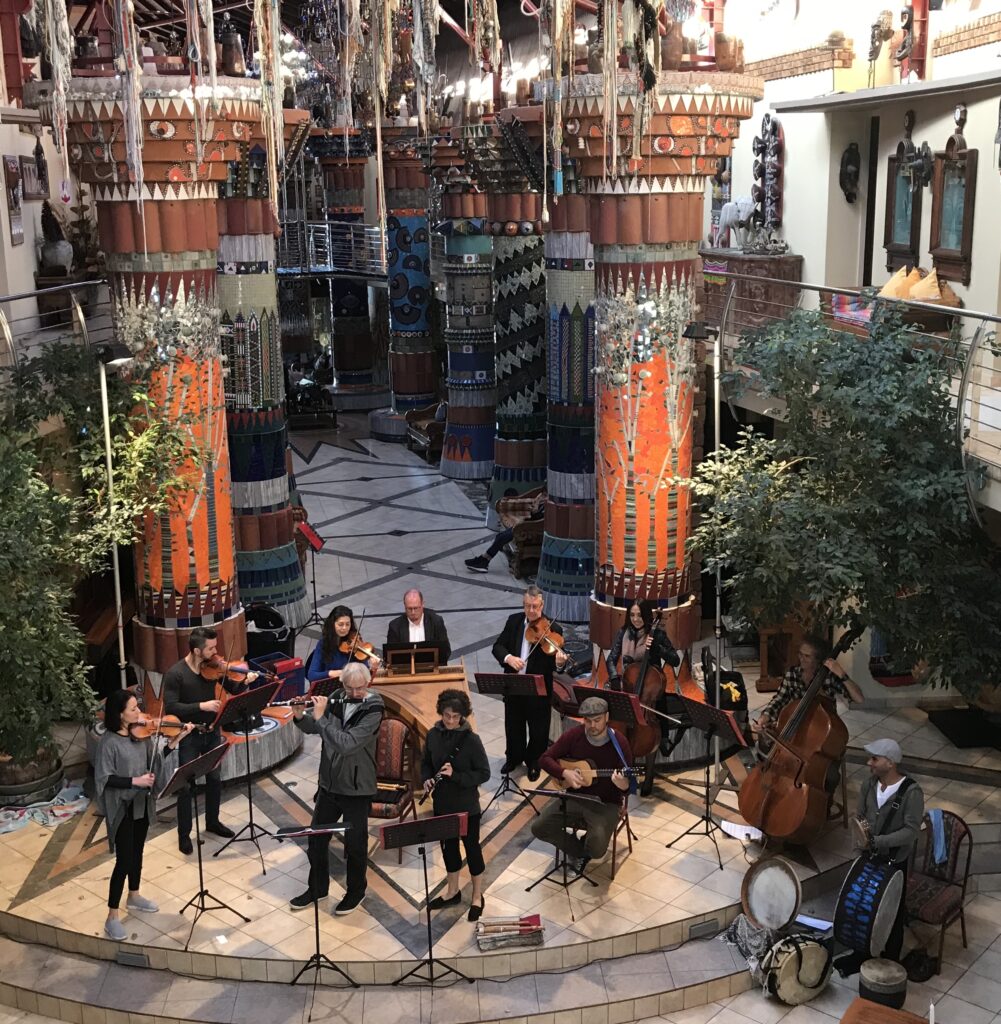
Their Oct. 18 & 19 program at Le 9e, for example, will combine Vivaldi with 18th-century nomadic music. This is certainly not the first time the ensemble has offered such a musical fusion. Their 2007 Analekta album, Vivaldi et les Gitans baroques, explored the Venetian composer’s Slavic gypsy inspirations, followed by the similar Telemann et les Gitans baroques two years later. For Maute, the fiery character of Vivaldi’s La Follia, RV 63, or his motet In furore iustissimae irae, RV 626, which will be performed by soprano Jannelle Lucyk, a 2025 Mécénat Musica Discovery, naturally complement the music from the Uhrovska collection of gypsy music also on the program.
“We know that Vivaldi had a wild temperament—that he would fly off the handle at the slightest opportunity,” says Maute. “He had a lot of passion within him. In my opinion, that’s where his true genius lies: putting together organized musical thoughts [like those]capable of inspiring Bach, while touching us right to the heart. It’s music that lives in the present moment, just like that of the nomads.”
To support his argument, Maute also draws on historical facts and documents. “Vivaldi himself went to Prague and the surrounding area to stage his operas,” he says. “Along the way, he met musicians from the countryside whom he heard play. Telemann wrote about this in one of his three autobiographies, stating that a week spent with nomadic musicians was enough to draw insights that would last a lifetime. Today, only one collection of their people’s music, so to speak, exists [nicknamed “Uhrovska” and compiled in 1730].
“These are just melodies—almost 350 in total—transcribed in an unconventional manner indicating the time signature at the beginning of each measure,” Maute explains. “Oral tradition and notation came together for a unique moment in history, around this collection, and we ourselves drew a lot of material from it. I made arrangements, improvisations, and all sorts of ornaments. It really changed my way of making music, and I also believe it changed the way the members of Ensemble Caprice approach their playing. We can go from a wild register to something very profound, which results in melodies that are difficult to harmonize according to the rules of the tonal system. It’s very modern from that point of view.”
A Cultural Meltdown
Larivière agrees, highlighting the transformative experience the ensemble had in contact with music not from the baroque or classical repertoire, which led them to found the ClassiqueInclusif program.
“It’s a project that’s really close to my heart,” she says. “It’s about reaching out to communities, musicians, and, whenever possible, composers. Our first season [in 2022]focused more on South America. Not only did we have new colleagues, we gave them a voice, but we also played in that community. We found ourselves in concert halls often adjacent to churches, as the Latin American community is very fervent. On these occasions, people come to share their immigration stories. Some are moving, and it’s very touching for me to see all aspects of diversity, not just musical.”
To ensure the smooth running of this program, Caprice relies on violinist and artistic director Karin Cuellar Rendon, originally from Bolivia, who creates a bridge between the orchestra’s musicians and those from the communities, thus contributing to the spirit of dialogue. “I see it as music of the future in the sense that all the voices combine to create new music,” says Maute. “There’s a social aspect, but also an artistic one focused on the idea of a society where [coexistence]has become the norm, at least here in Montreal.”
Recently, Caprice produced a recording project as part of the ArtChoral series, released by ATMA Classique, with First Nations composer Andrew Balfour, which echoed Larivière’s personal story. “I grew up near a reserve, Kahnawake, south of the Mercier Bridge,” she says. “There was a lot of racial tension surrounding the Oka Crisis in 1990, which lasted several months. So, for me, doing this project was even more valuable. We presented it at the end of August on the Indigenous reserve. The people in the room lived on the reserve, and we were able to talk with them. It was a wonderful experience.”
This season will be primarily devoted to the Middle East, Larivière explains, with a concert on Nov. 18 at Le 9e with musicians Ziya Tabassian and Karin Cuellar Rendon. The program features works by Sayyed Darwish, Halim El-Roumi, and Joaquín Rodrigo, alongside Corelli and Purcell. “Of course, we know baroque music,” says Larivière. “We experience it through our instruments. We do a lot of research, but we’ve always wanted to explore other music as well.”
Orchestral projects, begun about 15 years ago, have also greatly contributed to the demanding nature of Caprice’s repertoire, as evidenced by Beethoven’s symphonies on period instruments and Bach’s Mass in B minor, which earned the ensemble an Opus Prize in 2009. “This component now plays a fairly important role in our seasons, with concert series at Maison symphonique. It allows us to realize our dream of playing classical and romantic music on period instruments. This is done much less here than in Europe.”
Collection of Instruments
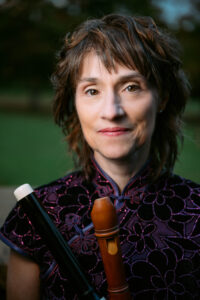
As a result, Maute and Larivière own around 40 flutes, including seven-key transitional romantic flutes. These predate the introduction of the Boehm key system, which would later revolutionize most wind instruments, explains Larivière. “The recorder is an instrument that runs in families, certainly during the Renaissance. So there are all formats. In addition, when you look at the transverse flute and the baroque [flute], you find a variety of instrument tones in different countries.
“In Quebec, we have an extraordinary maker, Jean-Luc Boudreau. Many of our recorders come from his workshop. For the transverse flutes, we called on Boaz Berney, who lives in Montreal. Bob Marvin, for his part, lives in Woburn and makes exceptional instruments, among the best in the world. The waiting lists for a consort—a Renaissance recorder ensemble—are very long. We are fortunate to have one as well.”
Caprice’s co-artistic directors have been fortunate enough to participate in several symposiums on the recorder and baroque music, ensuring they maintain close contact with the field.
The Four Nations
Apart from Vivaldi, Maute believes there isn’t much top-notch historic flute repertoire. “The loss of several of his concertos is a tragedy for recorder players. I’ve long hoped to be able to do something about it. The pandemic has provided the perfect opportunity.”
For their newest recording, the performer and composer set himself the goal of reconstructing three of the four concertos known as The Four Nations. Il Gran Mogol, a reference to India, is the only one that has survived. Maute only had the titles of the other works, linked respectively to France, England and Spain, but he did not seek to imitate any particular school of composition related to each country. “The Indian concerto [played on transverse flute by Larivière on the recording]gave me a good idea of how to put the others in place. You can see how little descriptive The Four Nations had to be, compared to the concertos of The Four Seasons, which are very figurative. The elements I used, therefore, belonged much more to the Vivaldian style than to clichés attributable to certain countries,” explains Maute, who had previously reconstructed the lost music of the opera Motezuma in 2013.
“There is a whole exchange between the 18th and 21st centuries. At that level, that’s what the arts allow us to do: transcend the limits of space and time, enter a world that is not our own, and return. The beauty of this project is that it’s an artistic—and not a musicological—playground where we can wear masks, as if we were at the Venice carnival, and step into Vivaldi’s shoes.”
The rest of the album (reviewed on p.43) includes pieces that are not by Vivaldi, but reflect the character of each country. The recording concludes with a version of Spring from The Four Seasons, this time revisited by Maute. His desire to compose came at the age of 16 or 17, he says. “I had no idea how to do it, having not studied composition before or after. For me, it happened as an autodidact when I studied the masters of the past, starting with the 17th century. I composed works following certain styles. This is also a bit like the way of learning that was typical in the 18th century, in a master-and-apprentice dynamic. This is how I learned the trade.”
Translation: Wah Keung Chan
This page is also available in / Cette page est également disponible en:
Français (French)