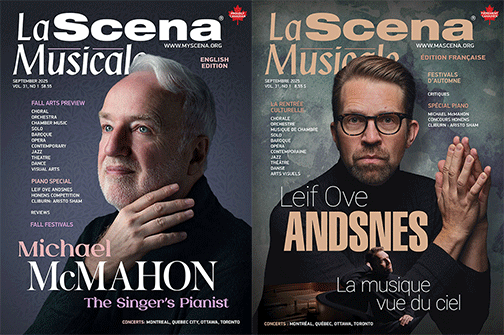
This page is also available in / Cette page est également disponible en:
 Français (French)
By Emma Yee; interview by Wah Keung Chan
Not many pianists, no matter how accomplished, can say they learned lieder from Elly Ameling; taught alongside famed language and diction pedagogue Nico Castel; and accompanied Maureen Forrester, Gerald Finley, Richard Margison, and Catherine Robbin. Or have been passed the torch by the founders of McGill University’s famous opera and song interpretation programs. But as Michael McMahon says, he’s “worked really hard, not because [I have] to, but because [I love] it so much.” The pianist and professor who, on April 17, 2025, was awarded the Order of Canada.
McMahon grew up in Montreal, in a musical family. “Everyone played piano except for one brother,” he says. “Six of us played piano. My mother loved music and my father loved poetry. So I ended up doing what I do because it’s a nice blend of poetry and music. How about that?”
At the age of 10, after being taught by nuns, McMahon started studying piano with Olga Lukashevitch, a violinist who sparked his collaborative spirit. “On Sunday afternoons, [she]would take out her violin and make me sight-read through some very, very difficult music,” McMahon explained. Lukashevitch would also get McMahon to play for his singer friends at end-of-year studio concerts. In fact, McMahon’s early adeptness in collaboration led him to study with veteran Hungarian-Canadian pianist and educator Charles Reiner, at McGill.
After two years of an ill-fitting commerce program at Sir George Williams University (now Concordia), McMahon spent six years at McGill. He accompanied, played for choirs, and took the song interpretation class at McGill, which he now helms in its 50th year. He remembers being busy, and reminisces about his mentor Reiner. “Charles asked me: ‘Do you want to learn to play the piano or do you want a degree?’ And I said: ‘Well, I want to play the piano.’ ”
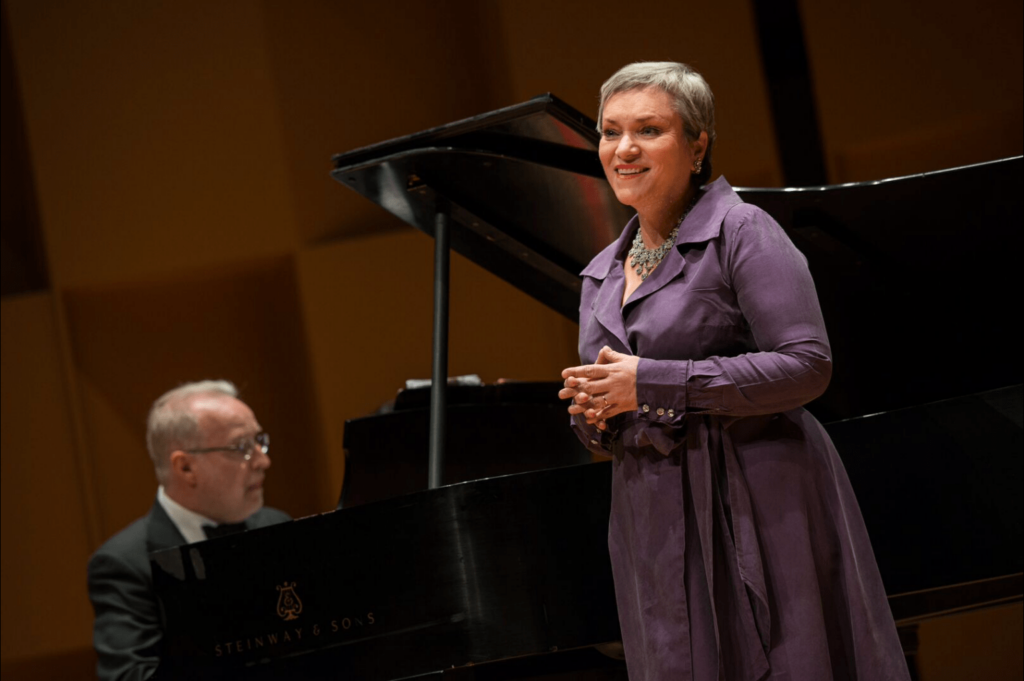
From there, his studies brought him to Austria. In 1978, McMahon attended the first Franz-Schubert-Institut, which he describes as a sort of “lieder Disneyland.” Participants work on lieder—mainly works of Schubert, Brahms, Liszt, Wolf, and Mendelssohn—with days consisting of one hour of poetry, five hours of master class, and three hours of coaching. They also immersed themselves in their Austrian milieu, walking in “the same woods near Baden that Beethoven and Mozart walked in. And the houses where [we taught]are directly across the street from the church for which Mozart wrote the Ave verum corpus. Beethoven finished the Ninth Symphony in that town,” says McMahon. They took cruises down the Danube. When McMahon was a student, teachers included Hans Rothe, Hans Hotter, and Kim Borg. Now, teachers include today’s lieder greats like Robert Holl, Roger Vignoles, Julius Drake, and Helmut Deutsch.
The institute’s mainstay, who has taught there since 1978, is soprano Elly Ameling, who has long been a champion of McMahon. While in Canada in 1981, she told a master-class audience: “I don’t know if you know how lucky you are to have Michael here in Montreal.” For the last 15 years, McMahon has returned every summer as the institute’s main piano teacher.
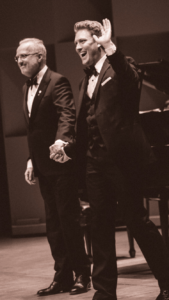
McMahon then studied with Erik Werba for two years at the Hochschule für Musik und Darstellende Kunst in Vienna, while also improving his German. “There’s no way I would have done what I’ve done without having that time in Europe.” He recommends that artists go to Europe, saying: “Everything that we do is generally European culture. And you need to go to the museums. You need to go to the opera houses. You need to go to the symphony. We do have very fine teaching in Canada, but we don’t have the same cultural activity that they have in Europe.” He also currently works to try to give young artists the same opportunities with his work as a board member at Debut Atlantic and the Art Song Foundation of Canada.
He did, however, want to return to Canada. “I just thought: ‘I want to share what I’ve learned,’” McMahon remembers, also mentioning that he missed family and friends in Montreal and the rest of Canada. Before he left Vienna, however, the next chapter of his career began.
“I was walking down the street in Vienna with my friend, Lois, who was going to sing [for]my final exam,” says McMahon. “She was a graduate of McGill. We were walking down the street [coming]out of the McDonald’s, [and]right [there]in Vienna, just on the Ringstrasse, come Edith and Luciano della Pergola, who started the McGill Opera, of course. And my friend knew them well. And she invited them to my final exam at the university, at the Hochschüle. And they came and they said: ‘Come to our hotel tomorrow and have tea with us.’ And they had already phoned McGill and asked if they could hire me. And so I got hired the day after I graduated. That’s how I started at McGill in 1980.”
After his time in Austria, McMahon filled a niche coaching German repertoire in Montreal where the piano expertise up until that time had been more focused on French repertoire. McMahon has now been a mainstay at McGill for more than 40 years. He is currently co-head of voice and runs the McGill-Université de Montréal Piano-Vocal Arts Residency, in which six pianists are brought to Montreal for nine months to develop as collaborative pianists, répétiteurs, and vocal coaches, working with singers from McGill, Université de Montréal, and Opéra de Montréal’s Atelier lyrique. This past year, the residency featured guest artists such as La Scala’s head vocal coach James Vaughan, German pianist Hartmut Höll, English pianist Julius Drake, tenor Ian Bostridge, and French baritone François Le Roux.
McMahon has also been teaching the song interpretation class for more than 40 years. He describes the 40th anniversary concert of the class as a career highlight: “I brought in four former students who had been in song interpretation class, who are now teachers. So I brought Dominique Labelle, Donna Brown, Anna Maria Popescu, and Benjamin Butterfield. And then I brought four younger ones, who were early in their careers 10 years ago. And it was Gordon Bintner, Philippe Sly, Rihab Chaieb, and Jacqueline Woodley.”
Although McMahon is mostly known for teaching pianists and singers working in major opera houses internationally, he is also an active, accomplished performer in concert and on recording. Recitals with Catherine Robbin, Joseph Kaiser, and Karina Gauvin were career highlights. He recalls playing for legendary Canadian contralto Maureen Forrester and says: “It was such a complete connection.” His 2004 album of Brahms lieder with contralto Marie-Nicole Lemieux was listed on Gramophone’s “50 best Johannes Brahms albums”.
For his work in radio, McMahon credits the late CBC producer Frances Wainwright, who in 1981 asked him: “What can I do for you? Who would you like to work with?” He notes: “I found out, on the day after Frances died, that I received the Order of Canada. And it was very sad. The first person I thought of was my mother. But the next person was Frances Wainwright.”
To young pianists who want to work with singers, McMahon says “they need to learn to sing,” and “be open and flexible to different interpretations.” He compares working with different singers to paintings of the same subject, saying, “to me, the singer is the one who provides the lighting for the subject that is already written there by the composer.” He tells pianists to be flexible, taking into account the size of the voice, the acoustics of the hall, the piano, and to be able to make those decisions on the spot.
To singers, McMahon stresses the importance of learning language. He recalls watching an actress recite and fully understand a poem, saying, “you knew how just incredibly honest it was. You have to find not just what you think, but what you feel about the pieces, and really connect it to your own emotions.” McMahon emphasizes that he is a lifelong learner. For example, although he has played Schumann’s Frauenliebe und Leben since 1978, every time he looks at it, he sees “something new—whether it be an articulation or a chord or harmony or understanding a little better about how the music fits the words or why the composer wrote that time signature.”
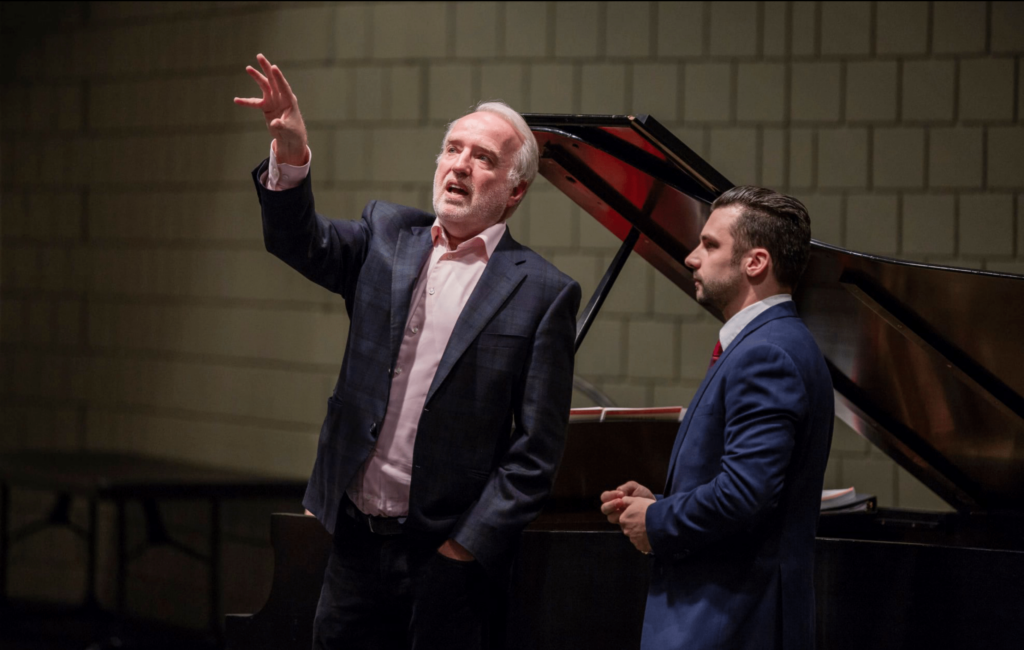 When asked about his favourite composers, McMahon cites Schubert, Brahms, and Wolf for their songs, but also includes Mozart, Puccini, and Verdi. His top pieces to listen to are Mahler’s Symphony No. 2, Schubert’s Winterreise, Brahms’s Requiem, Bach’s B minor Mass, and Puccini’s La bohème. Winterreise shows up again under McMahon’s favourite pieces to play, alongside Ravel’s La valse for two pianos, Bach’s C minor partita, Mahler’s Ich bin der Welt abhanden gekommen, and Schubert’s Erlkönig. While his favourite pianists are Martha Argerich, Murray Perahia, and Glenn Gould, McMahon is hesitant to name his top three favourite singers, “Oh no, I can’t do that one,” he says. “I know my rights. I want to live.”
McMahon has seen his legacy play out through his students and his many honours, but he remains incredibly humble about his success. “I’ve been so very lucky to be doing this career for this long,” he says. “Having the opportunity to make music for your career is incredible. It’s a real blessing to be able to do that. I never thought at 16 years old—it never occurred to me that I could be a professor. It never occurred to me that I could have a life as a professional musician. So to get this Order of Canada, you have no idea how much it means to me.”
This spring, McMahon will give a recital with soprano Aline Kutan and clarinetist André Moisan at Bourgie Hall, presenting Schubert lieder, including his Shepherd on the Rock (Feb. 22).
www.residence-pav.com
www.mcgill.ca/music
www.artsongfoundation.ca
www.debutatlantic.ca
This page is also available in / Cette page est également disponible en:
Français (French)