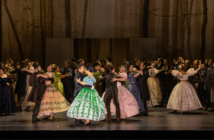
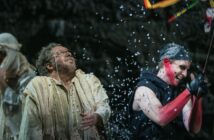
With the Paris Opera’s 2026 season now in full swing—and offering several genuinely striking productions, Eugene Onegin directed by Ralph Fiennes among them — this Un ballo in maschera (seen Feb. 8) feels thoroughly routine, save for the presence of Anna Netrebko and Ludovic Tézier.
Verdi’s Ballo occupies an intriguing middle position in his output. Written in 1859, it belongs neither to the early “galley years” nor to the fully mature period of Don Carlo or Otello. It is a transitional work in which political drama, psychological shading, and melodic brilliance coexist somewhat uneasily—a piece that can support, and even invite, interpretive risk.
None is taken here.

Photo: Franck Ferville
Staged by Gilbert Deflo, a Flemish director long associated with major European houses and traditional repertory staging, this Ballo exemplifies the perfect house craftsman production. Dependable, discreet, and institutionally safe, it has been dutifully revived since its 2007 premiere. Like much of Deflo’s work, it avoids interpretation in favour of clear narrative and generous space for star singers to collect applause—which they duly do. The result is a staging that has proved durable and easily revivable, if only because there is so little in it to age. What once passed for restraint now reads as the serene confidence of a production entirely convinced it has nothing to say.
Two stars on the playbill—Netrebko and Tézier—and, let’s be honest, many in the audience would be perfectly happy to stop reading there. They have come to applaud, they know exactly when to start, and they do so with admirable consistency. Everything else unfolds in the generous margins between ovations.
There is no question that the evening’s strongest moments occur precisely in the scenes where Netrebko and Tézier are left alone to do real dramatic work: Amelia’s “Ecco l’orrido campo” in the gallows field and Renato’s Act III aria “Eri tu che macchiavi quell’anima” are highlights. Their duet, the scene in which Amelia pleads to see her child, and the subsequent confrontation—when Renato realizes that she is not the one who deserves to die, but Riccardo—are the moments in which the opera briefly acquires depth, tension, and moral clarity.
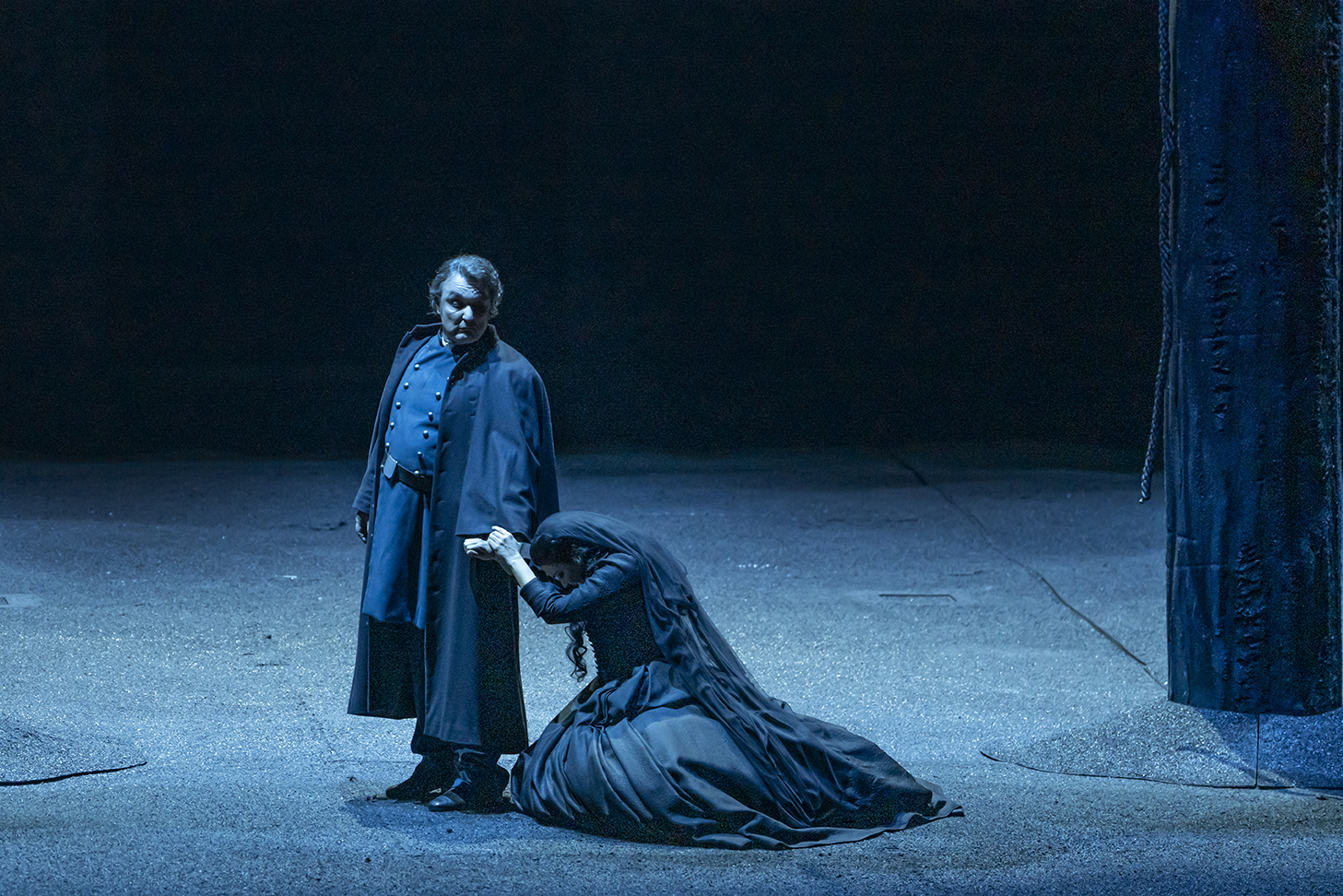
Photo: Franck Ferville
Elsewhere, interest dissipates quickly. Without the gravitational pull of these encounters—and without directorial pressure to shape the surrounding material—the performance lapses into inertia. What should be a drama of intrigue, danger, and fatal miscalculation becomes, for long stretches, simply dull.
But if you came to hear Netrebko at the top of her game, bringing absolute assurance to a role she now fully inhabits, singing opposite Tézier—one of today’s great dramatic baritones in equally formidable form—you probably left the Opéra Bastille fully satisfied.
Tézier’s Renato supplies the evening’s moral gravity: all dark pressure and inward burn, brooding with purpose. Like Netrebko, he does not wait for guidance. Both arrive with their performances essentially pre-assembled. Years of experience in major roles and sustained collaboration with serious directors have given them a universal roadmap. They generate their own dramatic weather.
They are joined by Elizabeth DeShong as Ulrica, who is excellent. Vocally ample, theatrically grounded, and refreshingly free of witchy clichés, she briefly makes the opera behave like a drama. The prophecy scene is gripping: time suspends, fate enters, consequences feel unavoidable.
The illusion is reinforced from the pit by Speranza Scappucci, whose conducting is alert, responsive, and structurally intelligent. Orchestra and chorus do the heavy lifting usually expected of the stage: shaping tension, pacing events, and supplying the dramatic spine the production declines to provide. Musically, the evening is often first-rate.
Then the routine resumes.
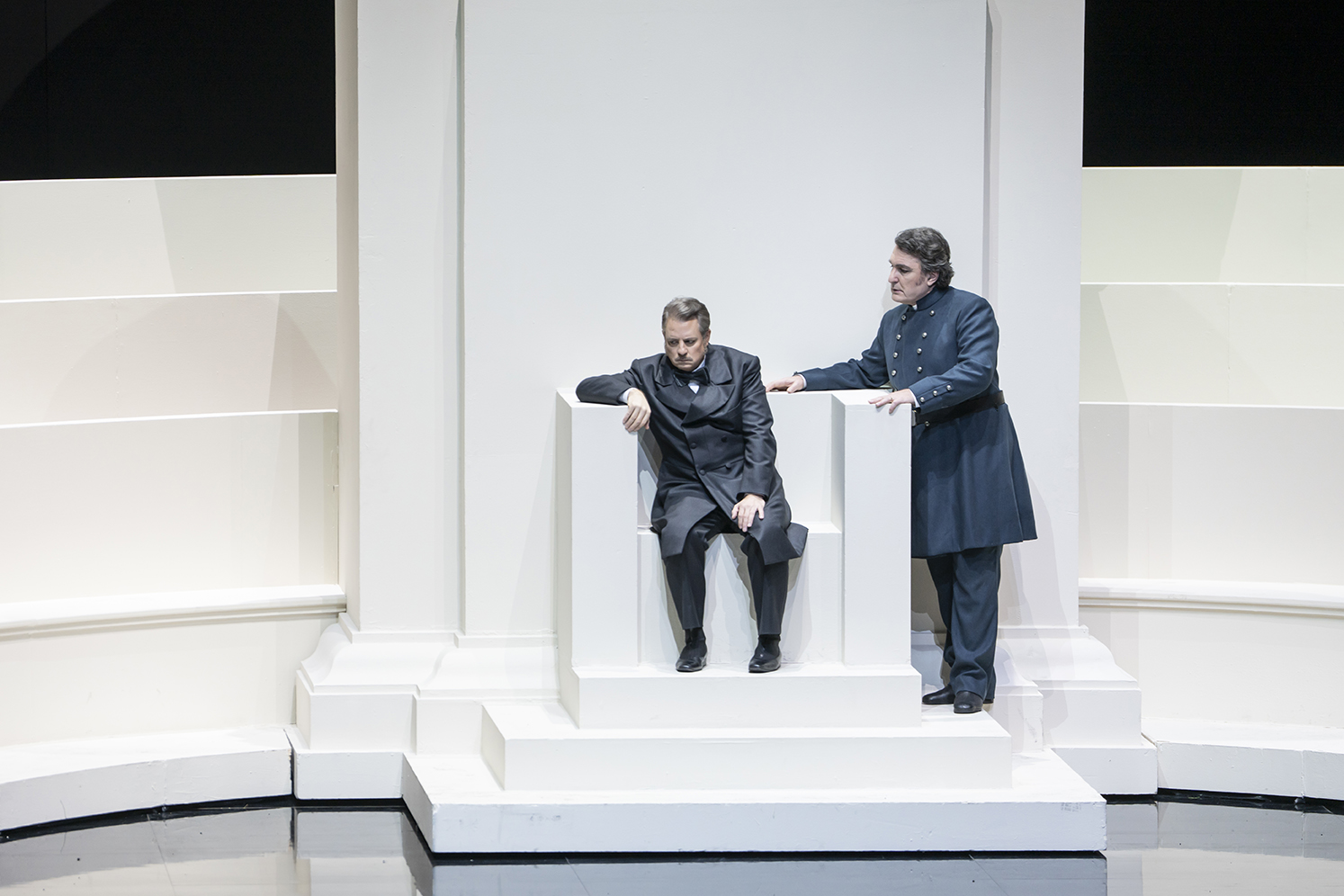
Photo: Franck Ferville
Matthew Polenzani’s Riccardo is vocally secure but dramatically underdefined. Verdian style, nuance, and—more crucially—charisma are in short supply. Riccardo should inspire affection, risk, and danger; here, he registers instead as a figure oddly disengaged from his own fate. Authority never fully takes hold. Without it, Amelia’s attraction feels abstract, Renato’s jealousy difficult to credit, and the assassination oddly procedural.
Sara Blanch’s Oscar suffers from the same absence of direction. Though the voice is beautiful—particularly in the higher coloratura passages—it is lost in the lower register. The characterization appears unpacked from the standard trouser-role starter kit: cherubic, busy, generically pert. One glimpses Cherubino, the Composer, Octavian—all without their specificity, danger, or purpose. Oscar should flash through the texture like a blade; here, she barely dents it.
Which brings us back to the staging—or, more precisely, its prolonged leave of absence. The Deflo production suggests a simple working method: Don’t try anything radical. Be agreeable. I’ll be back. Relationships remain unshaped, hierarchies undefined, and tension unorganized. As a result, scenes that should crackle simply lie there: the Act II confrontation between Riccardo and Renato never ignites; the final masked ball proceeds without fatal momentum. The décor—rich in eagles and vague allusions to royalty and America—gestures earnestly toward symbolism, then stops. Iconography replaces thought.
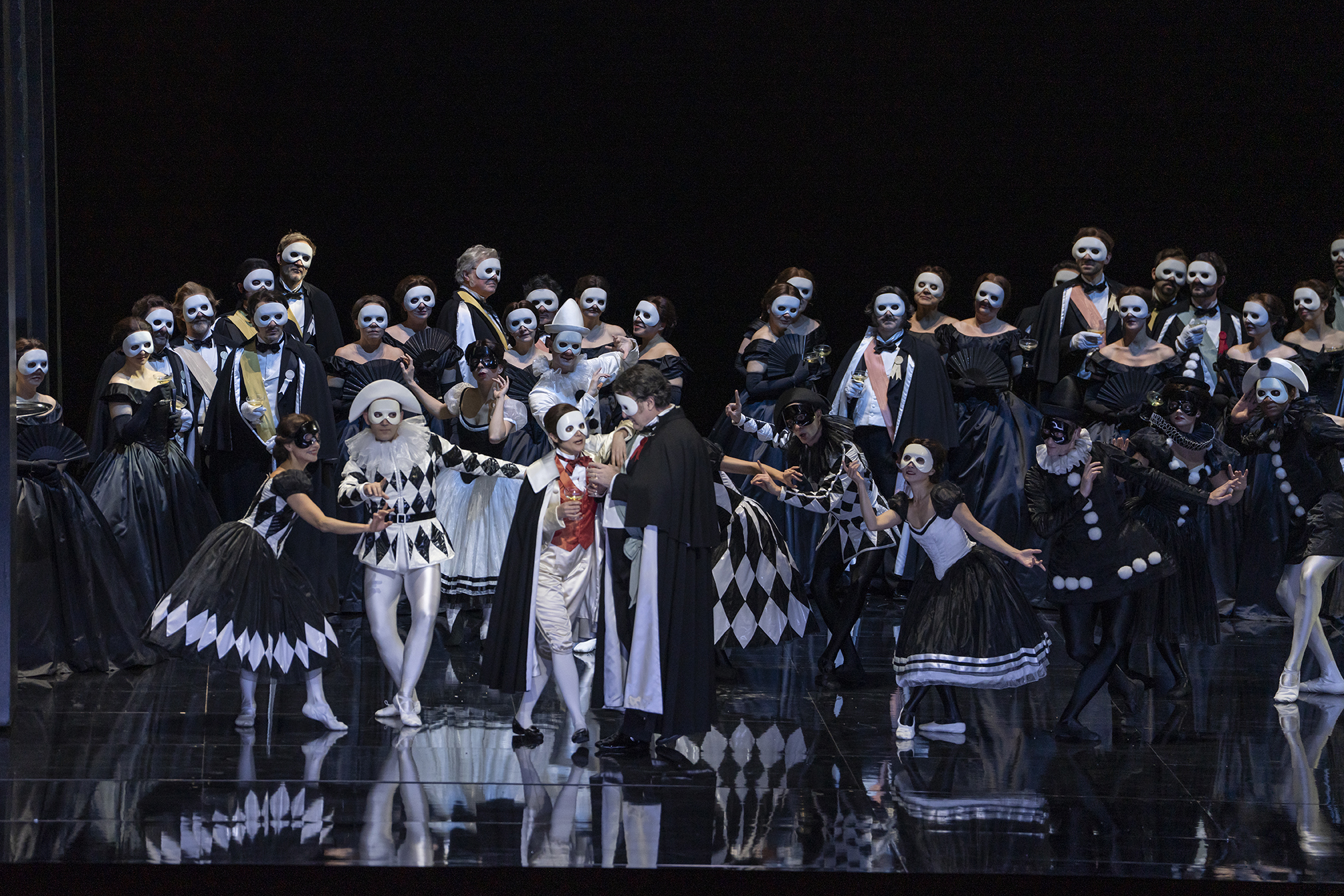
Photo: Franck Ferville
What remains is not so much a production as a collection of individual coping mechanisms. Some artists—Netrebko, Tézier, and DeShong—are strong enough to impose coherence where none is offered. Others are left exposed. The failure here is not one of excess or provocation, but of abdication.
For Netrebko’s admirers, grateful to hear Amelia sung with this degree of power, commitment, and authority—especially alongside Tézier’s Renato and Scappucci’s disciplined musical leadership — the evening may well have felt like a triumph.
For everyone else, this Un ballo in maschera served as a reminder that in the absence of a dramaturgical vision, even with great voices left to carry the burden, the opera’s centre does not merely wobble.
It vanishes.
Opéra national de Paris’s Un ballo in maschera continues its run through Feb. 26.