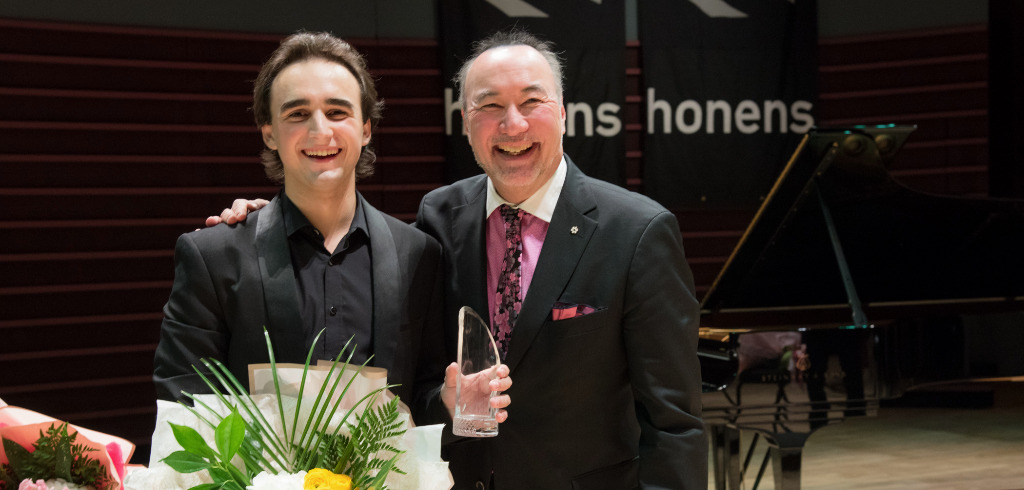
Esther Honens, after whom the triennial Calgary international piano competition is named, wanted to leave a legacy that reflected her civic pride and her love of piano. In the fall of 1992, thanks to her $5 million endowment, the inaugural Honens International Piano Competition was held at Calgary’s Jack Singer Concert Hall, where the competition’s ailing benefactor sat in a specially-built private booth to see her vision fulfilled. Honens died five days after the first Honens finale, at age 89.
Her legacy continues this October when 10 young pianists compete in the 11th Honens for substantial cash prizes and a three-year career development package. The winner’s take is $100,000.
The Honen’s first two administrators, Andrew Raeburn and Stephen McHolm, grew the competition into a world-class event, but neither came from the world of elite classical pianists. In 2018, renowned Canadian pianist Jon Kimura Parker became artistic director. Parker wasn’t new to Honens. At age 32, he was part of the competition’s first jury in 1992. He returned as a special guest for the gala opening in 1996 and was a juror once again in 2012. One year, one of his students competed, so he was there in spirit.
“I felt my connection to Honens was really organic,” he said.
Parker believes Honens was looking for someone who had walked in the shoes of the young competitors he would now help test and nurture.
“What I think Honens wanted was a Canadian concert pianist who could truly speak to the experience of competing,” Parker said in an interview from Orca Island, Wash. He famously won the Leeds International Piano Competition in 1984.
Roughly 150 pianists apply to the Honens, from whom 50 are selected to play for a preliminary jury. That jury selects 10 players to go on to the semifinals in Calgary. The 10 semifinalists are required to demonstrate their prowess at the keyboard, of course, but Honens aims to find what it calls “a complete artist” and, to do so, the contestants must show a variety of abilities that Parker says reveal a range of talents beyond mere piano playing. He wants to see “whether you can get a sense that the artist has a vision.”
The successful pianists will be comfortable performing solo recitals, but collaboration is essential for a successful career, and that means being adept at playing with an orchestra as well as supporting other musicians in smaller formats. This year, cellist Rachel Mercer will be one of the chamber-music collaborators. The pianists will play a cello sonata with Mercer and accompany her in a five-minute salon piece. The three finalists will also play a piano quintet with the most recent winner of the Banff International String Quartet Competition, the Isidore Quartet. They’ll also perform a concerto of their choosing with the Calgary Philharmonic Orchestra. Each collaborator will share with the jury their views on the pianists’ capacity to work with others.
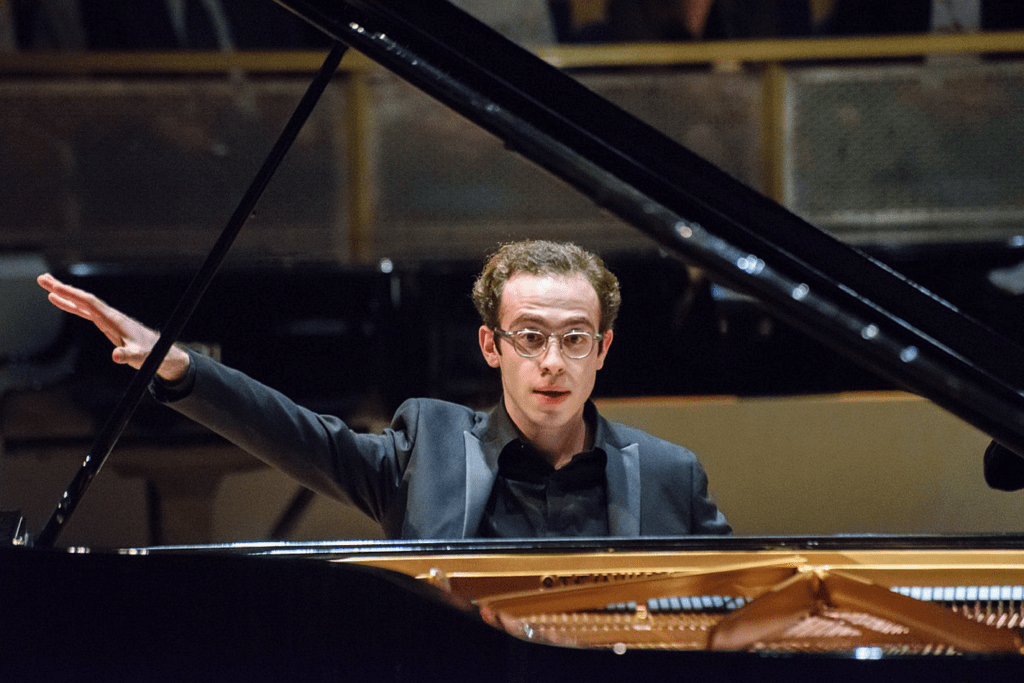
Some of the other hurdles include a half-hour interview, to which the seven jurors—a mix of high-profile pianists and impresarios—will be privy. As well, the finalists will choose a short encore, announced from the stage. “To see how they speak,” said Parker.
In 2022, (COVID pushed the contest forward a year from 2021), Parker began commissioning a new Canadian work all the players must play. Stewart Goodyear wrote this imposed piece in 2022, and Iranian-Canadian composer and pianist Iman Habibi has written one for 2025.
So how important is it for a talented musician to win competitions these days? At the beginning of Parker’s career, winning a big competition almost guaranteed a career. But conditions have changed.
“You can’t really say that anymore,” he said. “There are a lot of competitions, so that’s diluted the meaning of winning, to a certain extent.” Winning, though, may be even more important for a pianist than it is for other instrumentalists.
“Piano is different. A violinist who does rise to the very top competitively still has a chance to land a good job with a very good orchestra. There isn’t that kind of option for pianists,” Parker said.
At age 21, Ukrainian pianist Illia Ovcharenko was the youngest winner ever in 2022. In a telephone interview from Zurich, he said winning Honens catapulted him into the professional ranks. He entered several competitions before Honens, but doesn’t compete anymore because he’s too busy with actual engagements.
“Winning Honens has totally changed my life as a musician—as an artist,” he said, adding that the pressure-cooker atmosphere he experienced at other competitions wasn’t really there during Honens. Because competitors have plenty of chances in Calgary to show the jury where their strengths lie, the feeling he had was more congenial than it can sometimes be.
“It allows you to feel at home on the stage because you know, ‘I made it here. I made a little money. I didn’t waste any money.’” The seven players who don’t make the final all receive $2,500 each.
Honens runs from Oct. 15 to 24, including: performances by the two most recent winners, Ovcharenko and Georgian pianist Nicolas Namoradze; a recital by this year’s mentor-in residence Stephen Hough; and several master classes.