For many, Germany is the European country that comes to mind when it comes to Christmas, with its festive markets and overall celebratory ambiance. However, as a music lover, I find the second week of December in Milan to be especially enticing, as the 7th of December (San Ambrosio’s Day) marks the opening of the season at La Scala. This year opened unpredictably, with Shostakovich’s Lady Macbeth of Mtsensk, a twentieth-century Russian opera, instead of the expected Italian masterwork.
Following the season premiere, the rest of the season was unveiled, replete with recitals, ballet, chamber music and orchestral fare. With proper planning and some luck, it’s easy to hear four musical events at La Scala in the space of the same number of days.
As Milan is strategically located in Northern Italy, a 30-to-70 minute train ride brings you to other northern and central Italian towns who are either opening their new season or ending their 2025 season. Among these are Turin, Bologna, Parma, Verona, Piacenza, Modena, Reggio-Emilia, Cremona, Pavia, Bergamo, Brescia and Como. For the past few years, I’ve made a point of spending early to mid-December in Milan to enjoy these copious musical offerings.
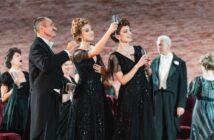
Though ubiquitous in the Anglosphere, Handel’s Messiah isn’t commonplace in Mediterranean Europe in the days that precede Christmas. The Monteverdi Choir and English Baroque Soloists, the first of La Scala’s guest ensembles this season, chose Handel’s oratorio as their featured work. Actually this was part of a tour they started two days earlier in Rome and were to continue in Paris and London.
Seen on Dec. 15, my first day in Milan, the featured soloists were some of the best I’d heard in this work. Portuguese soprano Ana Vieira Leite, who specializes in the baroque repertoire, possesses a brilliant light lyric soprano that she uses to great effect.

Photo: Brescia/Amisano
Britain’s Sarah Connolly’s mezzo contrasted with Leite’s soprano, though a contralto is the preferred voice for this part. An impressive singing actress, Connolly is a phenomenal interpreter with great stage presence and expressivity. Britain’s Andrew Staples impressed with his gorgeous and hefty lyric tenor. British bass William Thomas stood out thanks to his beautiful timbre and excellent delivery.
The Monteverdi Choir and English Baroque Soloists, established by John Eliot Gardiner in 1964 and 1968 respectively, are two British ensembles especially admired for their performances of Bach and Handel. French harpsichordist/conductor Christophe Rousset, founder of the French early music ensemble Les Talens Lyriques and a Lully specialist, has been the English groups’ leader since 2024. Their collaboration has been a triumphant one, as demonstrated in this performance, characterised by elegance and sobriety.
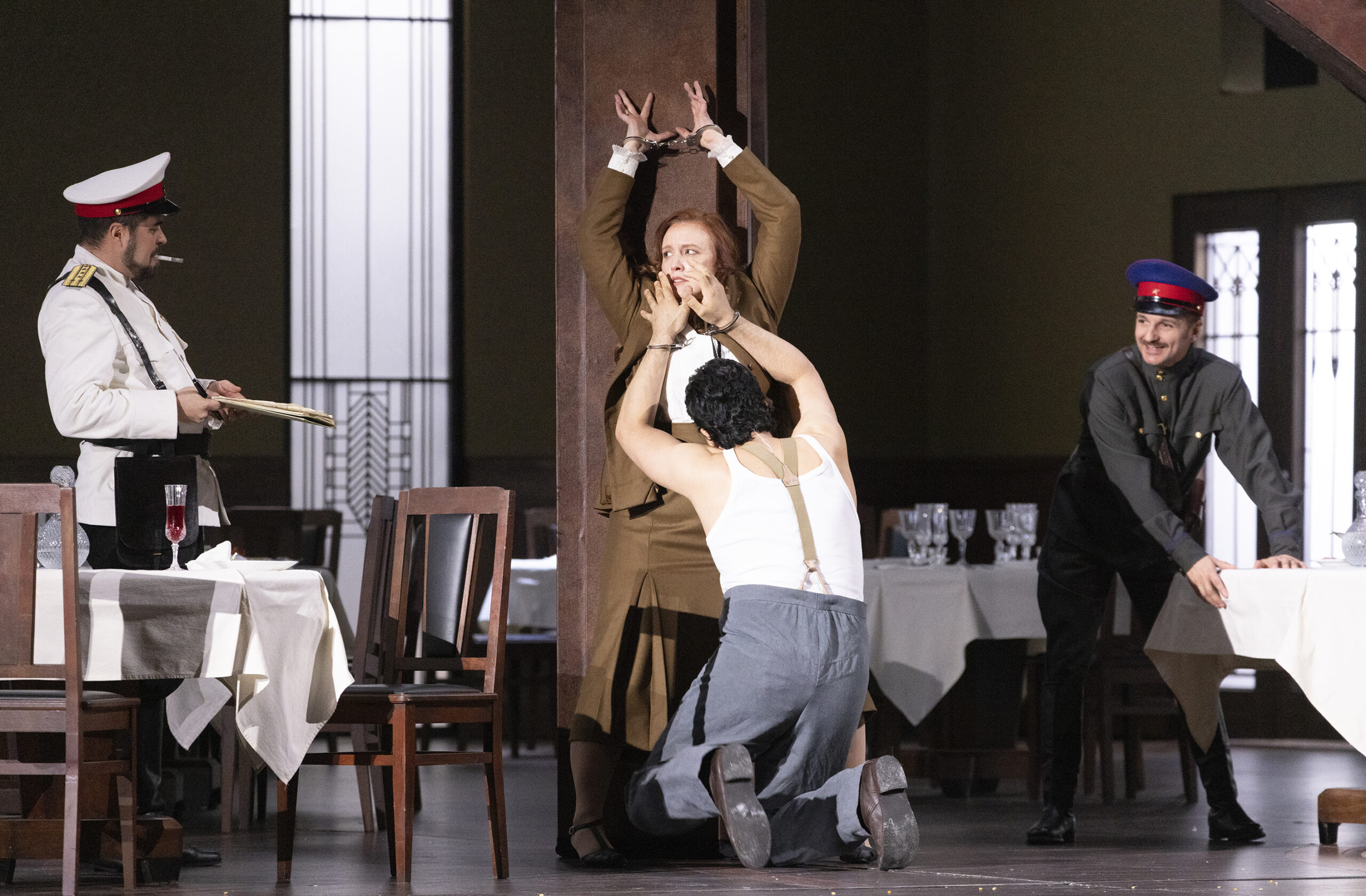
Photo: Brescia/Amisano
The production of Lady Macbeth of Mtsensk (seen Dec. 16) was truly remarkable thanks to an illustrious cast and a brilliant director, Russia’s Vasily Barkhatov. Forty-two-year-old Barkhatov’s vision of Shostakovich’s masterpiece was both inspired and original.
Given the stark, severe setting of the opera, where Katerina is married to the impotent son of a rich and domineering merchant, Barkhatov managed to convey oppression from the very start by using flash-forwards into future interrogations throughout the performance, especially during its interludes. A truly brilliant and à propos theatrical device.
This was the fourth of seven performances of the opera. After the second act of the previous performance, conductor Riccardo Chailly was indisposed and unable to return to the podium. No assistant conductor took over, to the great dismay of the public. Thankfully, Chailly was in top shape during this fourth performance, with particularly thrilling violin and woodwind passages.
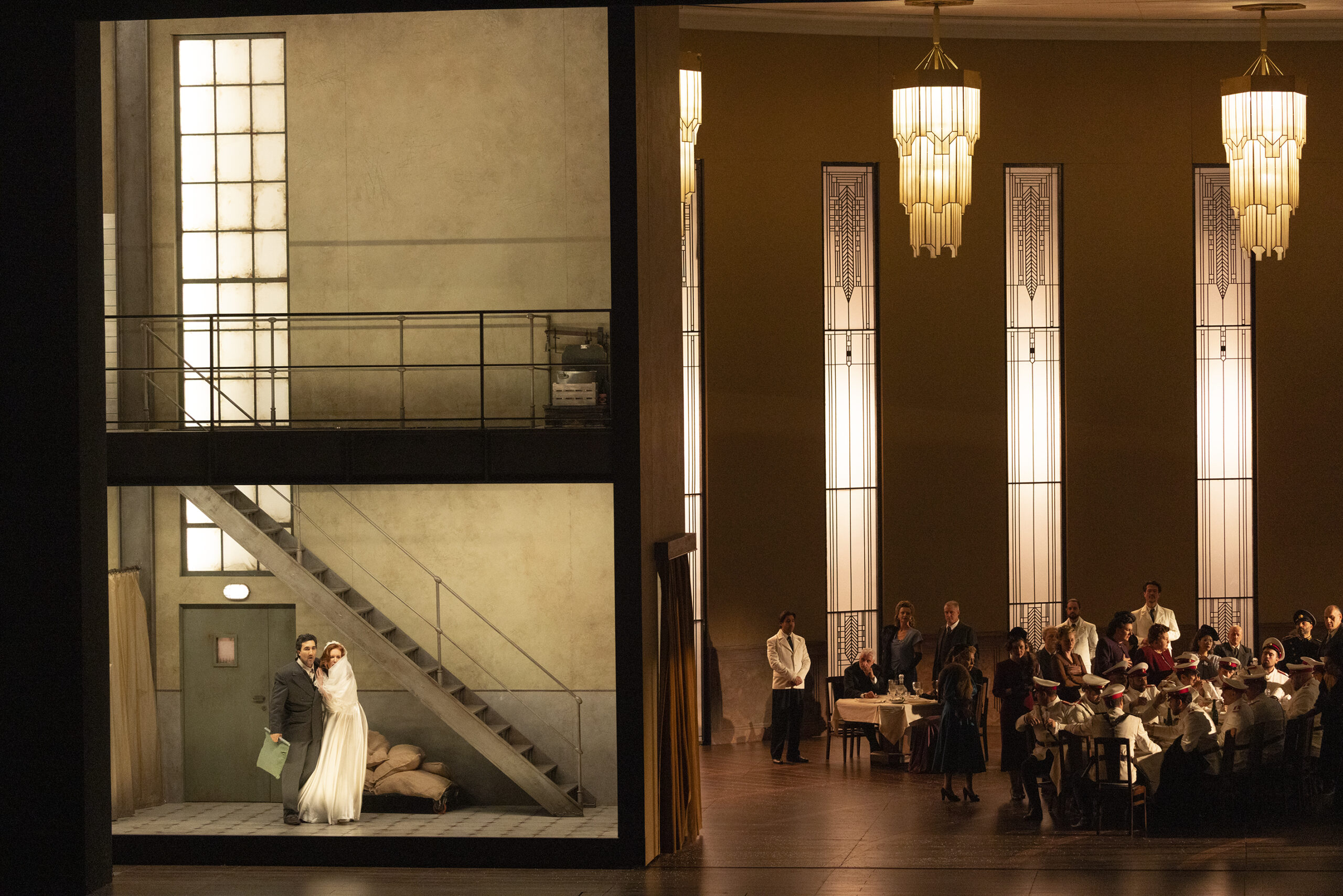
Photo: Brescia/Amisano
The fabulous sets were surprising, as they resembled fin de siècle Vienna rather than provincial Imperial Russia, the opera’s setting. A gorgeous art déco restaurant was the setting chosen by Barkhatov; supposedly part of Katerina’s overbearing and tyrannical father-in-law’s business empire. The restaurant had an esplanade from which a brass band played during the interludes.
The sets also afforded an upper level, where the kitchen, the establishment’s underbelly, was located. A panel separated the restaurant from the interior of the Izmailov home which showed the patriarch’s office, or alternatively Katerina’s bedroom.
Despite the beauty of the sets, Katerina’s paroxysm was well-conveyed and almost made one sympathize with her. Belarusian bass Alexander Roslavets was a remarkable Boris Timofeyevich Izmailov, the powerful and overbearing patriarch. Endowed with both a powerful voice and stage presence, Roslavets aptly portrayed a ruthless businessman and domineering family patriarch.
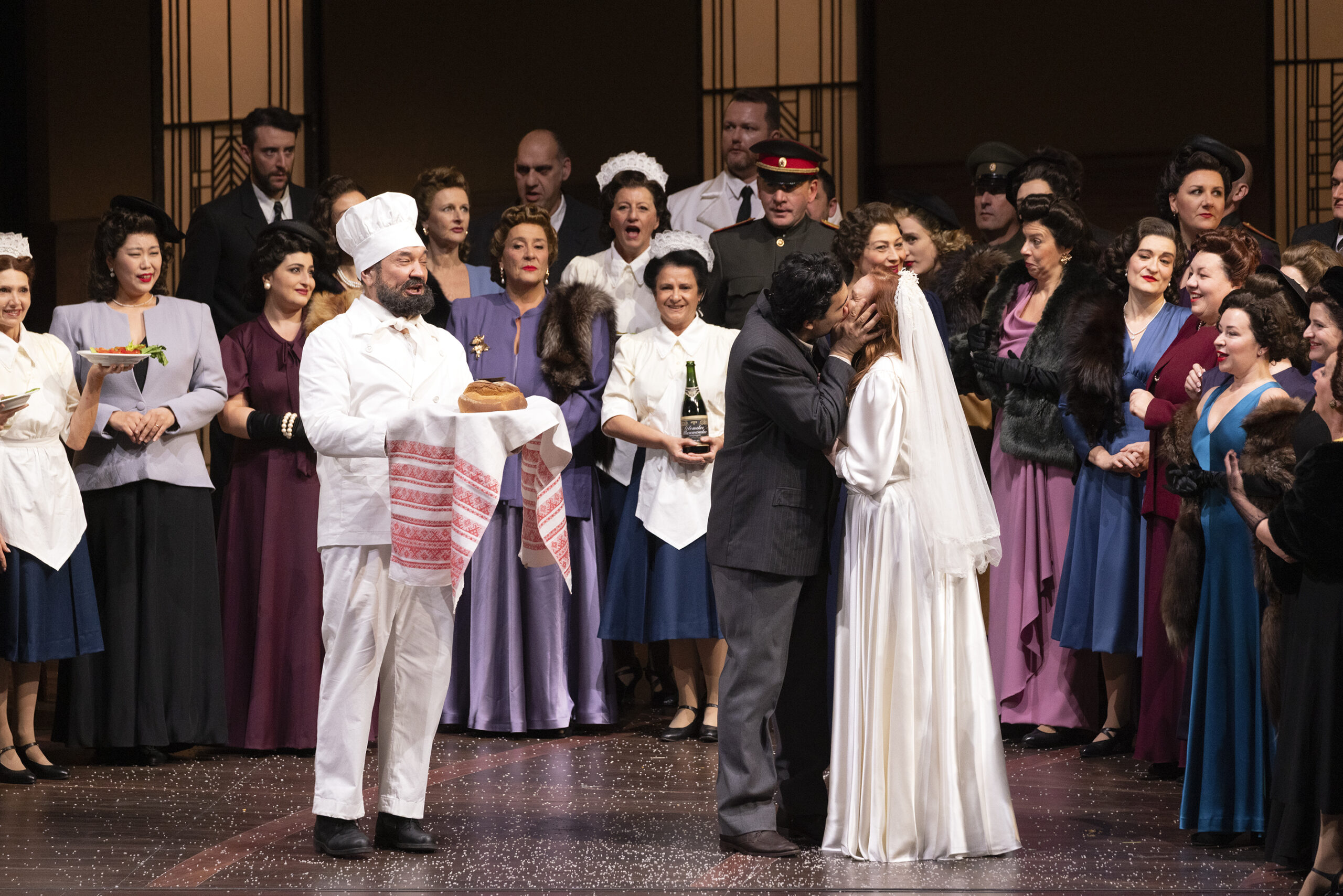
Photo: Brescia/Amisano
Russian tenor Yevgeny Akimov was Katerina’s impotent husband Zinoviy Borisovich Izmailov, pathetic and weak. Despite his pathetic nature, one almost felt compassion. Akimov brilliantly used his high tenor to add a nagging quality to the impotent cuckolded husband. Uzbek tenor Najmiddin Mavlyanov was an appropriately manly and seductive Sergei, Katerina’s lover and partner in crime. His virile tenor appropriately contrasted with Akimov’s high tenor.
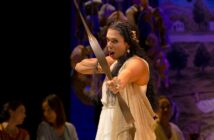
The uncontested star of the show was American soprano Sara Jakubiak, a truly incandescent Katerina. A magnificent singing actress, Jakubiak was the perfect choice for the opera’s anti-heroine. Thanks to her great charisma and Barkhatov’s focused directing, one felt sorry for Katerina despite her sordid character.
Both utterly amoral and weak, she embarks on a torrid relationship with the dissolute Sergei, despite having witnessed his attempted rape of a maid and, after violating Katerina herself. Endowed with a splendid lyric soprano with facility in the upper register, Jakubiak easily expressed rapture in lyrical moments as well as untold rage in tragic episodes.
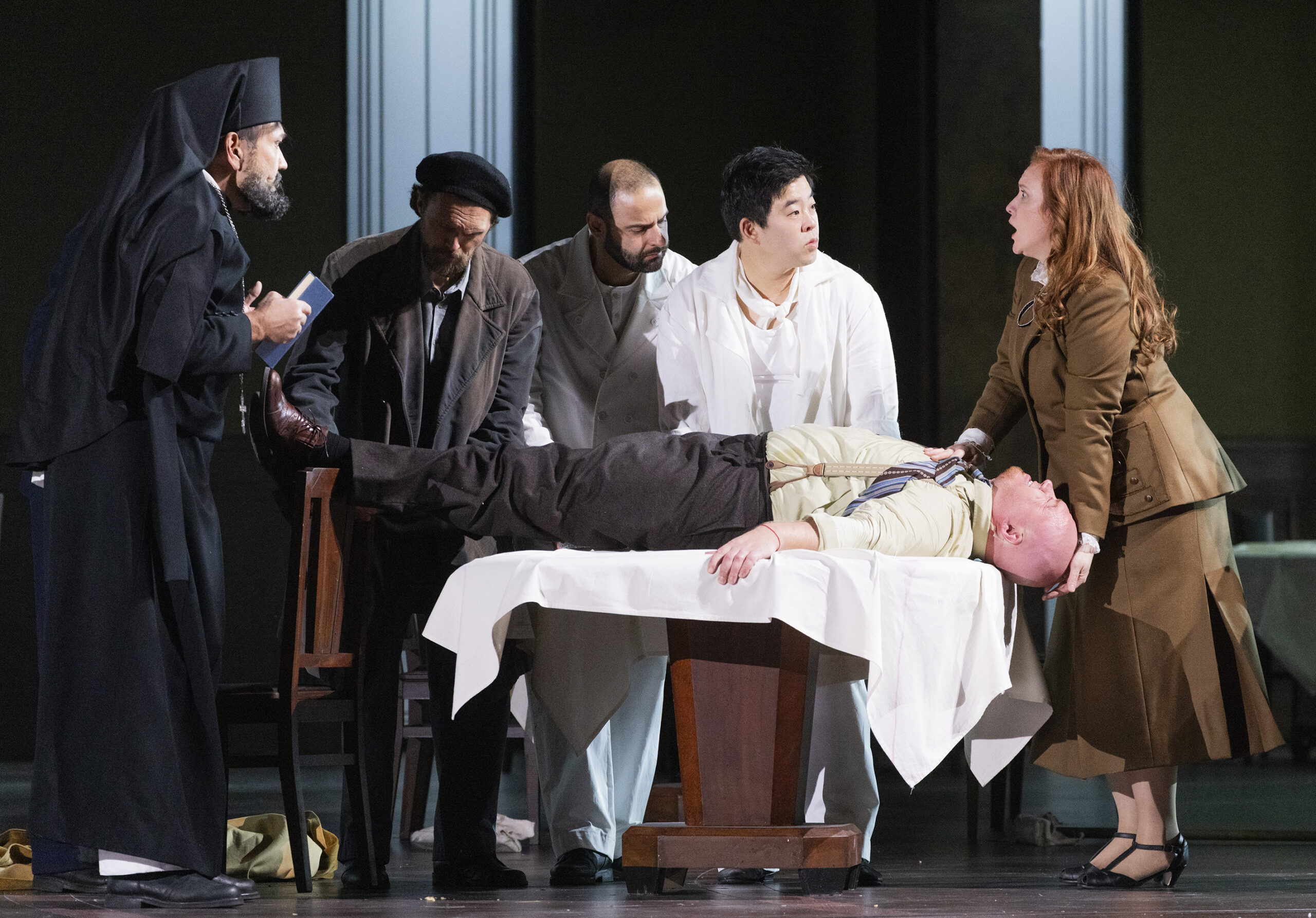
Photo: Brescia/Amisano
The public was already mesmerized by Katerina’s lugubrious deeds: poisoning her nosy father-in-law and strangling her husband to be able to continue her affair with Sergei, but Barkhatov‘s coup de génie was the twist he used in the final act.
When the corpse of Katerina’s husband is discovered by a drunkard in the cellar, the lorry in which Katerina and Sergei are to be deported to Siberia erupts into the art déco restaurant. The lorry’s tearing down the wall of the posh establishment was akin to a rape scene. The two murderers are captured and the elegant guests remain on stage as spectators until the end of the opera, a truly non-contrived breaking of the fourth wall.
Having rejected Katerina during their voyage to Siberia, the devious womanizing Sergei tricks her into taking off her stockings to bandage a feigned wound. It was but a ruse to gift the stockings to the female convict Sonyetka, with whom he makes love in front of a distraught Katerina.
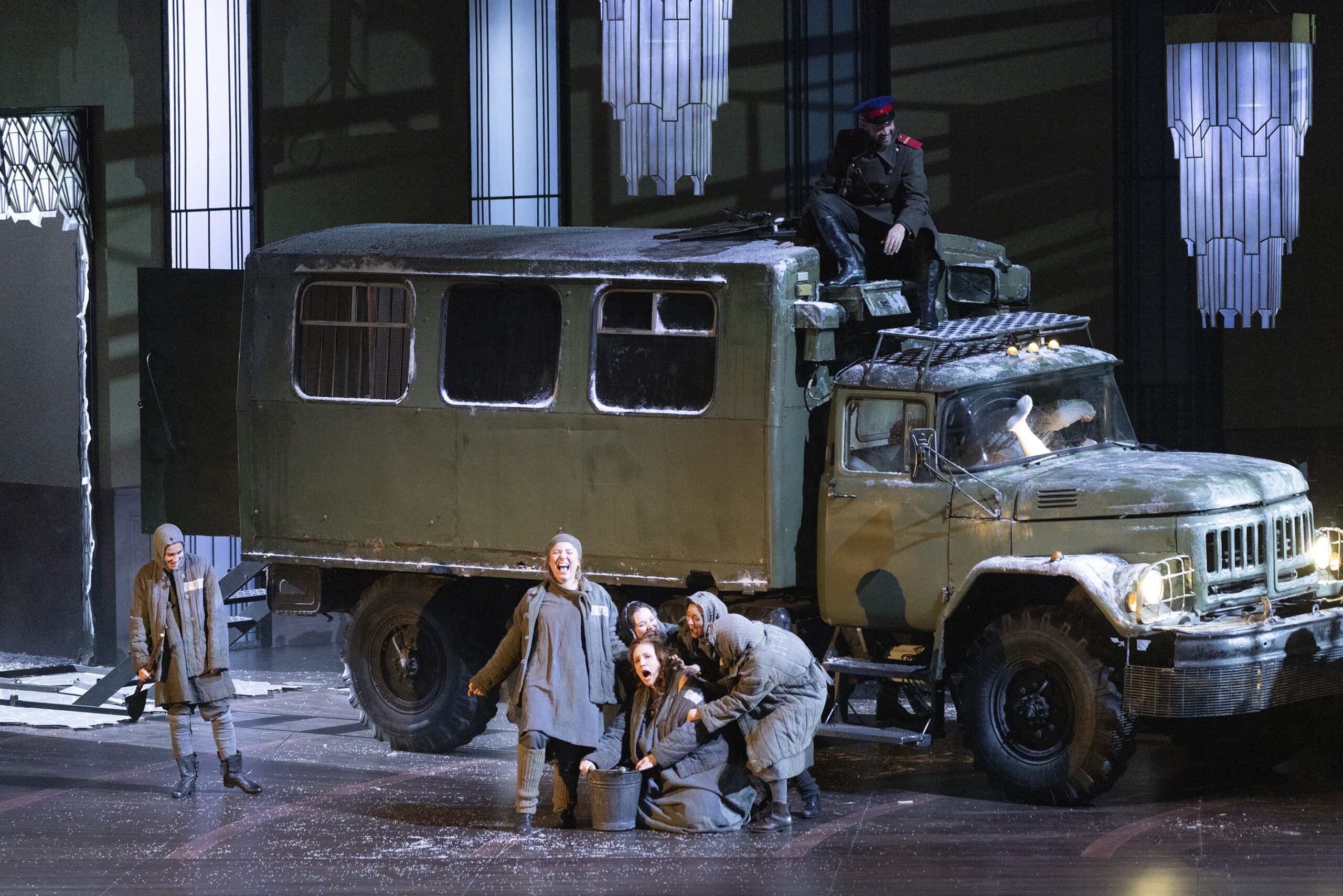
Photo: Brescia/Amisano
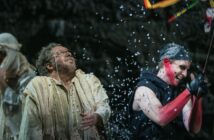
In the libretto, our Lady Macbeth pushes Sonyetka off the moving vehicle into a freezing river and accidentally falls off herself (or is pulled in by the falling woman). Barkhatov altered the ending: Katerina douses herself with gasoline, embraces Sonyetka and sets both ablaze. Obviously it is body doubles who undergo the ordeal before fire extinguishers leave two apparently charred corpses onstage. A fitting end for a bored housewife who came to life through flaming passion.
The theatrical effect was possibly the most spectacular I’ve ever seen onstage. Whether Jakubiak’s luscious voice, the orchestra’s glorious energy, Shostakovich’s powerful score, Chailly’s conducting or Barkhatov’s ingenious staging, this performance shot to the very top of my ‘best of 2025’ list.

Photo: Gianni Cravedi
As nothing was playing at La Scala on Dec. 17th, I chose one of the nearby towns. Out of several options, I chose a rarity, Verdi’s Stiffelio (1850) in Piacenza, a town of 100,000, a mere 35 minutes south east of Milan by train. The cast in this production would be the envy of the world’s top opera houses.
Veteran American tenor Gregory Kunde sang the title role, a Protestant preacher who discovers his wife’s infidelity whom he chooses to pardon. Seventy-two next month, Kunde is a vocal wonder, the only tenor to have sung the coloratura tenor role of Rossini’s Otello as well the dramatic tenor role of Verdi’s Otello. Of course, the former was early in his career, and the latter has been in the last decade. This smooth transition and amazing longevity are a testimony to Kunde’s intelligence.
Lina, the unfaithful wife was sung by the phenomenal Russian soprano Lidia Fridman, a brilliant and versatile soprano drammatico d’agilità I heard a year ago as Lady Macbeth in the French version of Macbeth at the Verdi Festival in Parma. Only 29, Fridman has become one of my favourite sopranos ever since.
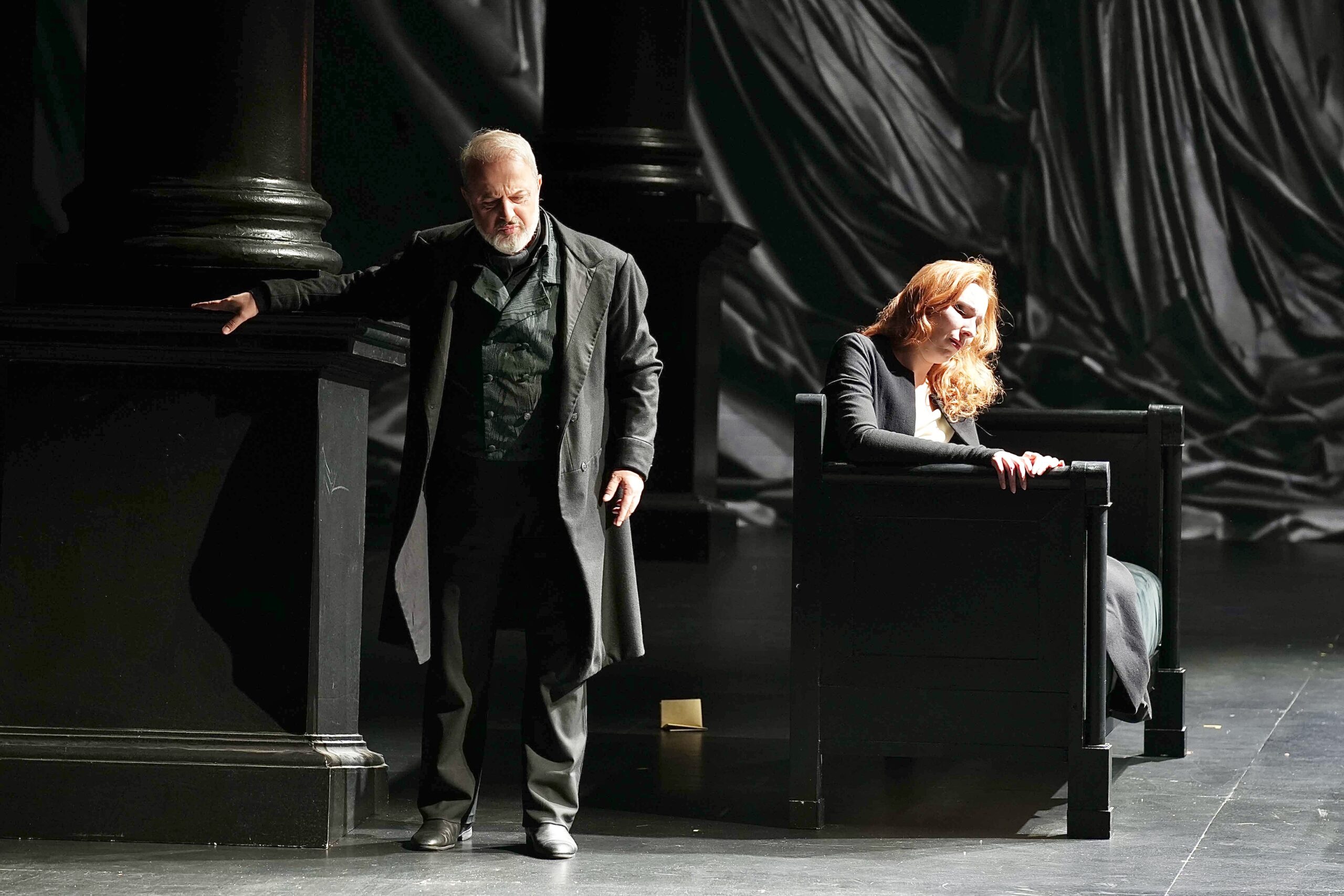
Photo: Gianni Cravedi
As Lina, she was truly moving in her Act I prayer “A te ascenda, o Dio clemente,” where she conveyed her guilt and torment in a number that eschews easy excess. Her Act II scene “Ah, dagli scanni eterei” is more typical of bel canto and Fridman managed to easily dazzle. Add to this her vocal excellence, incomparable stage presence and acting ability, Fridman has the whole package, and seems to be on the path to becoming one of opera’s most in-demand sopranos.
The third major role in the opera is Lina’s father, Count Stankar, valiantly interpreted by veteran Bulgarian baritone Vladimir Stoyanov. Now in his early sixties, Stoyanov is still at the height of his powers. His Act III aria, “Lina, pensai che un angelo,” in which he laments his daughter’s infidelity, was forceful yet dignified. Stoyanov aptly portrayed Stankar as a harsh and deplorable man, one who cannot control his emotions and kills his daughter’s lover. This contrasted with the noble nature of the forgiving Stiffelio.
Director Pier Luigi is 95 years old, and still at the top of his creative powers. Highly cultured, creative and endowed with refined taste, he managed to hold the public’s attention despite the insufficiency of the libretto. Conductor Leonardo Sini adopted a sober beat in his reading of this opera which, at times, suffered from Verdi’s penchant for the um‑pa‑pa beat he favoured in his earlier days but mercifully abandoned mid‑career. Sini managed to make that rather crude beat barely noticeable.
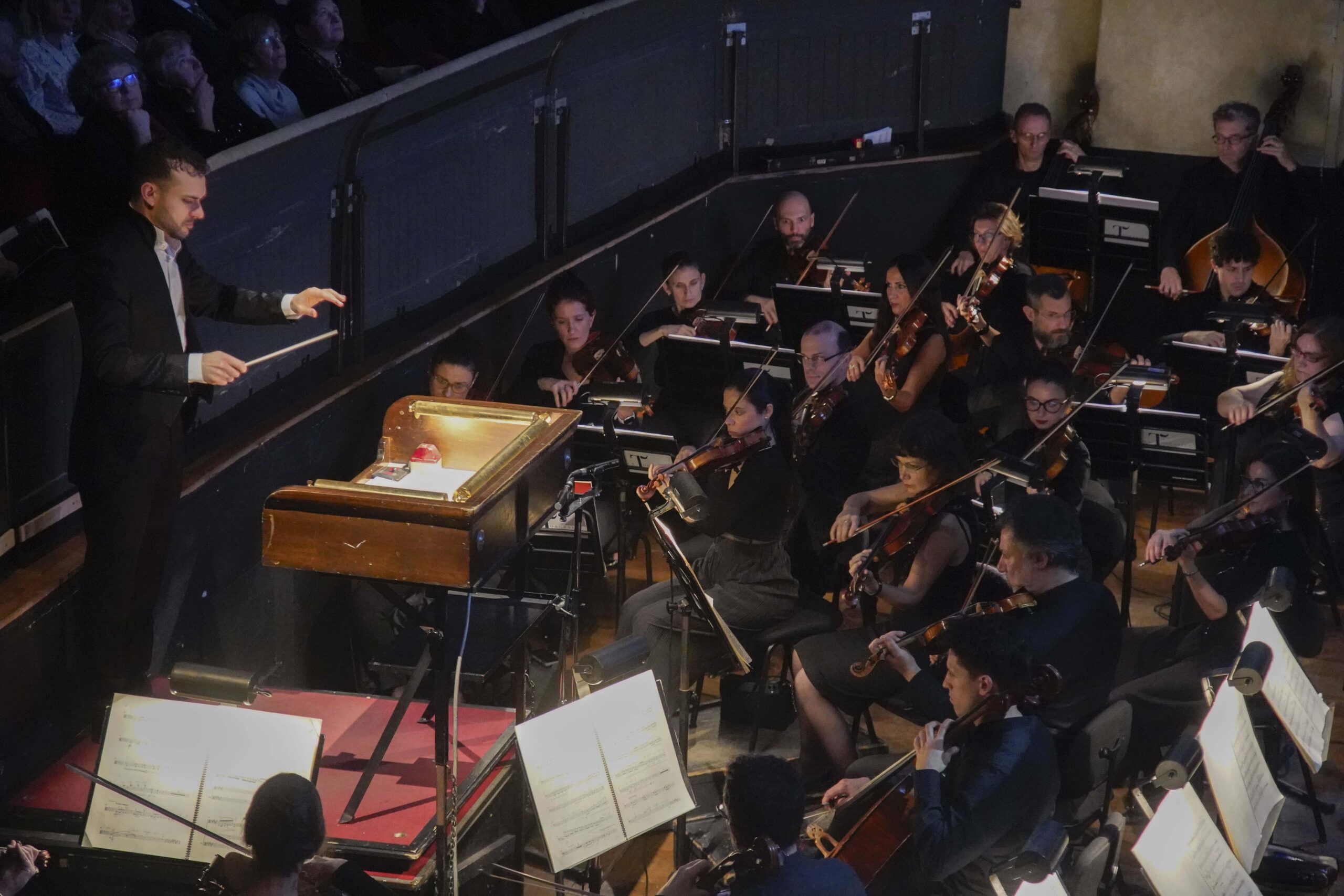
Photo: Gianni Cravedi
Though written between the successful Luisa Miller (1849) and the huge hit Rigoletto (1851), Stiffelio was a failure in both its initial form and again seven years later as the reworked Aroldo. Yet the opera contains some glorious arias and duets. The problem with Stiffelio is its weak libretto. With a cast such as the one in Piacenza, and a stage director and set designer like Pizzi, Stiffelio was in the end worthwhile. The problem is that, sadly, assembling such a high calibre cast and a creative and intelligent stage director is a rare event in today’s opera world.
Rudolf Nureyev’s production of Tchaikovsky’s The Sleeping Beauty (seen Dec. 18) opened La Scala’s ballet season. It was a delight to see that La Scala has preserved Nureyev’s productions. In the past couple of years, I have seen his Swan Lake, Nutcracker and La bayadère there. These, as well as the present Sleeping Beauty, are so well preserved that they can easily pass for brand new productions.
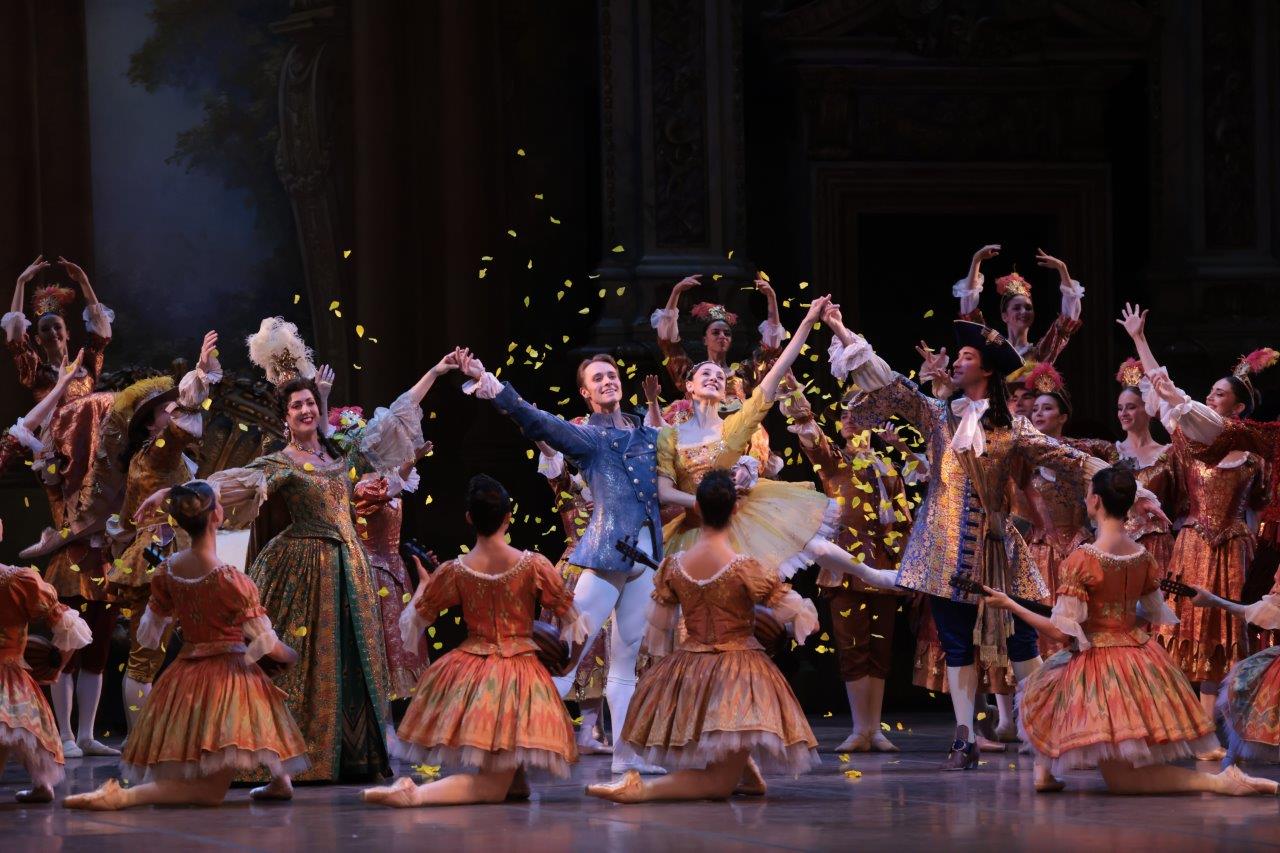
Photo: Brescia/Amisano
Of Tchaikovsky’s three ballets, Sleeping Beauty is the least performed in part due to the expense of mounting its elaborate sets and costumes. Nureyev considered Sleeping Beauty the “ballet of ballets.” When he conceived of this production, he introduced several modifications.
He insisted on presenting the lengthy work without the usual cuts; he directed costume designer Franca Squarciapino to lighten several cumbersome costumes; and he modified the choreography to favour the male dancers, especially that of Prince Desiré. One of La Scala’s premiers danseurs, Latvian Timofey Andrijashenko, was up to the role’s challenges, especially Nureyev’s demanding choreography. He dazzled with his impressive high jumps in Act III.
Though the part of Princess Aurore is not as pivotal as that of Giselle or Odette/Odile in Swan Lake, it’s a major role that ballerinas aspire to. Prima ballerina Nicoletta Manni was an ideal Aurore, graceful and expressive. Regularly partnered with Andrijashenko at La Scala, the two had palpable chemistry. They both dazzled in Act III’s pas de deux, one of ballet’s most romantic moments, requiring both technical perfection and expressivity.
Act III originally should contain all the characters from Perrault’s French fairy tales: Puss-in-Boots, Bluebeard, Tom Thumb and Cinderella. Nureyev did away with most, save Le Chat botté (Puss-in-Boots) and his female partner, La Chatte blanche. Though not overly demanding, Federico Fresi and Denise Gazzo shone in these roles, thanks to their elegant charm, which convincingly channeled feline cuteness.
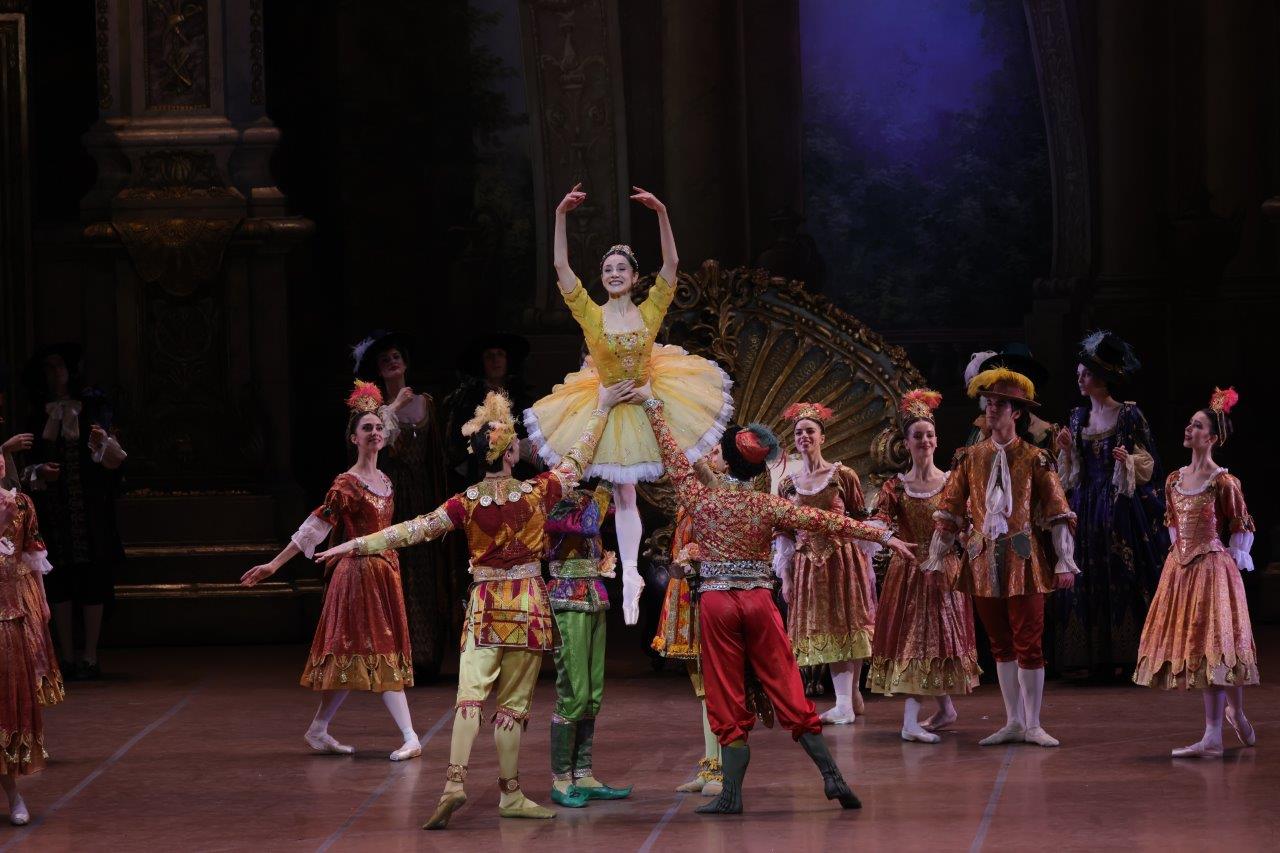
Photo: Brescia/Amisano
For many, the most memorable (though non-essential) character in the ballet is L’Oiseau bleu (the Blue Bird), danced magnificently by Darius Granada, whose high jumps gave the illusion of a bird’s flight.
The costumes for the evil fairy Carabosse and the good Lilac Fairy were truly magnificent, especially Carabosse’s black dress, which stood out among the bright colours of the rest of the costumes. Her horned familiars were quite frightening.
Comic relief is often provided by portraying Catalabutte, the Court’s Master of Ceremonies, as overly effeminate. It was he who forgot to invite Carabosse, thus causing the latter’s rage and malevolence. Mercifully, the present choreography eschewed this kind of dated characterization in favour of showing Catalabutte as pedantic and mannered.
American conductor Kevin Rhodes, a ballet specialist, conducted the Orchestra del Teatro alla Scala with elegance and brio. A great orchestra and conductor certainly enhance the enjoyment of ballet.
It was lovely to see Sleeping Beauty rather than the usual Nutcracker before Christmas. Though I love the latter, I think a fairy-tale-inspired ballet, such as this one or Coppélia, is entirely appropriate for the season.
More information on Teatro alla Scala’s season can be found here.