Playwright Tai Amy Grauman wrote her first draft of You used to call me Marie… in the Arts Club’s LEAP Playwriting Intensive about eight years ago. The play now returns at the intimate 237-seat Olympic Village Stage at the BMO Theatre Centre from Sept. 25 to Oct. 12. A Savage Society & NAC Indigenous Theatre production, You used to call me Marie… celebrates the love stories of Alberta’s Métis women—beginning with Marie Callihoo—from the 1930s to today as the Métis Nation rises across the plains.
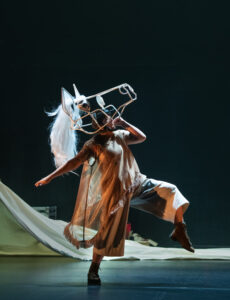
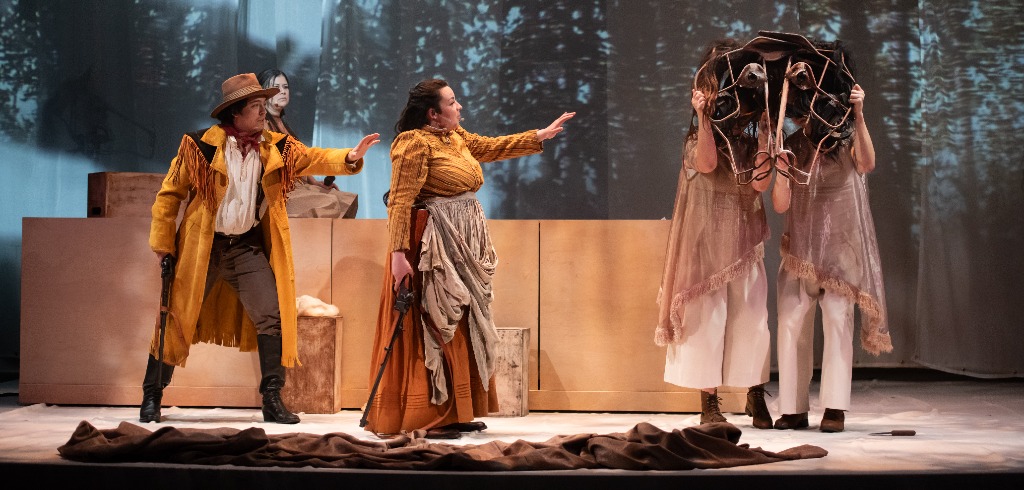
The play begins in the world of the stars. Actors dressed in cream and beige gallop onto the stage, holding hollow horse heads over their own heads and running around in uniform patterns. Soon after, three narrators weaved the story of Iskwewo and Napew, two lovers living in the star world, while strings played softly from off stage. When the woman Iskwewo falls from the star world, with Mistatim (‘horse’ in Michif) following behind, Napew promises to find her. The following love stories showcase how the two find each other through space and time.
Narrated by the ensemble—Carmen Alvis, Sophie Dow, and Krystle Pederson—this play emphasizes the role that oral storytelling plays in our understanding of culture and history. While some scenes pass without any comment from the narrators, their presence throughout implies that they are offering this historical epic to the audience. Rather than being passive observers, the audience is called to participate as active listeners, absorbing the knowledge being generously shared.

Between scenes, musicians come onstage and perform songs, sometimes solo and sometimes with others. The music ranged from French fiddle to contemporary country, according to the era of the scene. These interludes were some of the most lively and moving parts of the play. When fiddle-player Kathleen Nisbet would lead an upbeat song, the audience joined in by clapping their hands and stomping their feet as dancers Alvis and Dow spun around on stage.
Other times, the musicians sang soulful pieces, giving space for the audience to pause and reflect. One such song was Andrea Menard’s “Boy for One More Day/ Sur le Champ de Bataille” performed by Vocal Captain Pederson. Pederson’s performance was particularly vulnerable, showcasing raw emotion through her live vocals.
The main actors, Lynny Jeanne-Marie Bonin (Iskwewo) and Aren Okemaysim (Napew), enacted eight different love stories through tales of the fur trade, governance, and organizing from the 1930s to today. Bonin was particularly excellent at embodying the generations of Alberta’s Métis women, ensuring each character was distinct, influenced by their ancestors and the current events of the era. Okemaysim, an interdisciplinary performing artist, shone the brightest during the musical interludes. His voice and guitar playing were warm and welcoming, and it was in these moments that he seemed most comfortable on stage.

The greatest strength of You used to call me Marie… is Grauman’s writing. Through recurring motifs, Grauman highlights how the love story between Iskwewo and Napew transcends time. For example, in at least two of the different love stories, Napew searches in the dirt to find something to use as an engagement ring for Iskwewo. Similarly, a horse, Mistatim, almost always appears in their stories. Through these details, Grauman reveals the depth of their love.
This play, above all else, showcases the resilience of the Métis community. For many people, this production may be their first time hearing these stories, particularly those of the Métis women who Grauman centres in her writing. You used to call me Marie… opens the door for audiences to research more about these stories, which have been historically obscured by societal pressures and forced assimilation policies.
The Arts Club’s You used to call me Marie… runs through Oct. 12.