This page is also available in / Cette page est également disponible en:
 Français (French)
Jakub Józef Orliński is only 34 years old, but his media presence and aura have already launched him to the rank of one of the most recognizable personalities of the baroque music scene. Like many young artists, he started off quietly, without knowing where this life would lead him. In 2015, after already experiencing success singing roles in Poland and Germany, he began studies at Juilliard, New York’s prestigious music school, and became a finalist at the Metropolitan Opera auditions. And yet it was a unique event, on a July afternoon during a heatwave in 2017, that would put him on the map the next day: a performance on the sidelines of Festival Aix-en Provence he gave in casual clothes, broadcast on France Musique radio. A video was posted on YouTube shortly thereafter. The result: nearly 13 million views to date, an absolute record for countertenors.
Today, Orliński continues to share his artist’s life between classical concert halls and the streets of the cities he visits around the world. When doing this interview for La Scena Musicale, he was in the midst of preparing for an outdoor concert on the Esplanade of Heroes in Monterrey (Mexico) with the Santa Lucía Festival Orchestra, directed by Felipe Tristán. On Nov. 24, as part of the Festival International Bach Montréal, he will perform with his Polish compatriot, pianist Michał Biel, in an intimate recital at Salle Pierre-Mercure. “He’s my partner-in-crime. We travel around the world and we do recitals all the time everywhere. We rarely perform pieces by Bach unfortunately, but we will here and plan to include them in our future programs,” says Orliński.
An artist in the city
 Orliński’s previous—and first—visit to Montreal dates back to 2018, at the beginning of the wave of popularity that swept him up on social media. He sang Pergolesi’s adaptation of Stabat Mater by Bach, BWV 1083, in duet with a soprano at the Church of St. Andrew and St. Paul, at the invitation of the same Bach festival. The church was completely full, but as the singer says, “What I loved the most—I know it sounds weird—was after the performance. I always try to stay for signing sessions, or greetings. I talked to the public. It wasn’t officially possible but people were lining up and there was this guy who looked exactly like Santa Claus. He was so nice, incredibly cute, so we took a photo together for my Instagram [280,000 followers]. It was a fantastic experience.”
Orliński is living life to the fullest. Each concert, each tour, is the opportunity to discover an unknown place, culture, cuisine. He is also at the age where he is collecting memories by the ton, and he distills them for us delightfully. Montreal is certainly a part of this. “I absolutely loved the cute neighbourhoods, the great forest, the really good food. I tried this dish, people told me it’s the best thing after a hangover. I wasn’t in that state but it was amazing. I walked around a lot. Wherever I go someplace new, I like to explore. Here, I climbed the mountain. It was November so it was full of snow and I enjoyed the crispy air. The view over the city was gorgeous,” he says with a smile.
From Renaissance to hip-hop
Orliński’s love for exploration is translated into his taste in music. “I started in an amateur choir,” he says. “I sang music by Renaissance composers such as Thomas Tallis, Tomás Luis de Victoria, Palestrina, as well as the great Wacław z Szamotuł, a Polish composer whose name is unpronounceable for most people. We also sang Elton John and Beatles song arrangements. That was as a child. Later, I started listening to more classical music, especially from the Renaissance. I didn’t really listen to opera at the time. I discovered other composers during my studies. Of course, I knew Handel and Bach, but it was the first time I had seen sheet music and tried my hand at it. My passion, particularly for Handel, developed at this time. I love history in general. I’m not very gifted, since I can’t remember dates, but I love reading on this subject, as well as archeology. Seeking out forgotten works is a thrilling experience for me. I’ve worked with Yannis François, a very good friend, on many albums to find something that speaks to me, that has meaning for me and I want to share with my audience.”
In total, eight albums have been released with Erato/Warner Classics since 2018—an average of just over one album per year. This prolific discography has created a boundless eclecticism culminating in 2024 with the release of #LetsBaRock. With it, a new Polish group featuring Aleksander Dębicz at the piano, Wojciech Gumiński on the bass, and Marcin Ułanowski on drums was born. On their recording, listeners can experience the explosive union of baroque music, hip-hop arrangements, and original compositions.
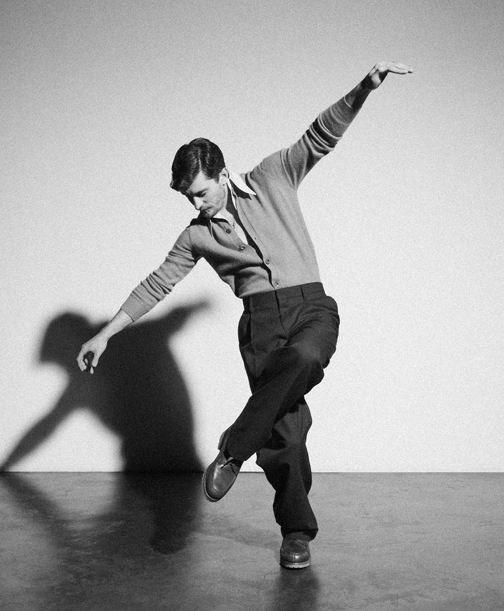
This balancing act is a joy for Orliński, who breakdances as a wonderful outlet for everyday stresses. His talent for vocal and physical excellence—at times a singer and others a street dancer, and sometimes both at once—has generated a lot of buzz. “In our shows, there’s a moment where we’re jamming and I’m doing hardcore flips. Same for the Beyond tour, there’s a part where my character is going through a moment of ecstasy, expressed through a little bit of dancing. Stage directors are also using my [dancing]abilities from time to time, but always when it has meaning. I don’t like to do a trick just because I can do it.”
With Dębicz, who made the arrangements and was the hip-hop songwriter on the most recent album, Orliński launched the first edition of the Break in Classic Festival, held this past Aug. 15-17 at the Museum of Interiors in Otwock Wielki, a Warsaw suburb. “It was a huge success, so we are already thinking of a second edition, and maybe a third one. It’s a lot of work. It’s not only choosing who’s going to come, but everything for that to happen. It’s exciting and satisfactory work nonetheless,” he says. The festival shares the same principles as #LetsBaRock: transcend the conventions of the classical scene so everyone feels welcome, dare to blend musical styles, and put the notion of pleasure back at the heart of artistic expression.
A passion for Handel
 Contrary to what one would guess, Handel only has a small place in Orliński discography. And yet, in opera or in concert, Orliński certainly doesn’t deny himself the pleasure of singing his works. “It’s not only that he’s my favourite composer, but I think I understand him. I read a lot about him, about baroque ornamentation, about his travels, his biography. It’s incredibly interesting to me. Also, because he [wrote for]two singers that probably had very similar vocal range to mine. All the things written for Senesino, for example, are actually very well fitted to my voice. Same goes with Carestini. It feels so good singing it.”
From Dec. 12-14 in Philadelphia, the countertenor makes a new foray into sacred repertoire, singing the alto part in Messiah conducted by Yannick Nézet-Séguin. “Arias like ‘He was despised’ can feel long and take forever to sing, but it’s our job as a singer and ensemble to maintain the audience’s attention, especially when the melody is repeated. The silences play a huge role in this case. It was originally written for a female singer [Susannah Cibber], but who wasn’t even a proper operatic singer. Rather, she was an actress, very famous for expressive interpretations. That’s why it is needed to have this energy. That being said, when it comes to sacred music, you don’t embellish that much because it would distract from the text. It should feel natural to the text as well as to the musical line. Yes, there’s freedom, [but]even more so in opera.”
Although his repertoire overflows with fiery arias like “Furibondo spiro il vento” from Handel’s Partenope, where all eccentricities and liberties are permitted, Orliński also knows how to showcase his angelic voice in more intimate arias that require emotional depth. “Pena tiranna” from Handel’s Amadigi di Gaula, for example, is one of the rare times he has sung an aria in a specially-produced music video. “I would love to do more acting in this kind of direction,” he admits, regretting that the classical music industry hasn’t followed the example of pop music in this regard. The pandemic provided a conducive environment for film projects, particularly thanks to funding from public partners, but normal practices within the industry have quickly reasserted themselves.
Orliński is delighted to be reprising Giulio Cesare, Handel’s famous opera, this coming February. An exceptional 12-concert tour is planned across Europe with the orchestra, Il Pomo d’Oro. The countertenor will sing the titular role alongside soprano Sabine Devieilhe as Cleopatra. He is especially excited for Feb. 23, when the tour will visit his hometown of Warsaw. “I don’t have the opportunity to sing in Poland that much but whenever I get a chance, it’s a great celebration,” he says.
A family of artists
 Orliński wasn’t born into a family of musicians, but they were music lovers. His parents were graphic designers and his grandfather, an architect. Art, exploration, and a taste for freedom were fundamental values with which he was raised. This would help prepare him for the career he didn’t yet know he would pursue. “My parents were always very supportive. They were open for me to try new things. That’s why I played tennis, some piano, rollerblading, skateboarding, capoeira, acrobatics… When I studied in a choir, they also drove me to the classes twice a week, to concerts, and camps. They were not sure if it would be something viable for my future. I myself didn’t know what it would be like. I decided very late to become a singer and go in this direction. I’m realizing just now how it actually helped that I was raised in a family of artists. My grandad had so many books; he was working from home, constantly drawing. There was never this feeling that I should be working from 9 to 5 like an office job. That gave me the idea of what it looks like, being a freelancer. It feels like it prepared me for all of that—including the artistic vision for things. My grandad loved to listen to music, not only classical music, while working. My parents would listen to a lot of music from the ’80s and ’90s, so I would listen to that, too.”
As the saying goes, you can take the boy out of the country, but you can’t take the country out of the boy. And so Poland goes with Orliński, in his thoughts and his programs. In Montreal, he will sing songs by Tadeusz Baird and Mieczysław Karłowicz. “Our recital is partly based on the album Farewells [2022] that we recorded, Michał and I, devoted to Polish composers. We [also]wanted to throw in some baroque pieces because that is what is coming up on our next album in March.”
Knowing Orliński, tours to Europe, Asia, and beyond will be in the offing for this new project.
Jakub Józef Orliński and pianist Michał Biel will perform works by Bach, Handel, Purcell, Baird, and Karłowicz at Salle Pierre-Mercure on Nov. 24 as part of Festival International Bach Montréal. www.festivalbachmontreal.com
Translation: Isabel Garriga
This page is also available in / Cette page est également disponible en:
Français (French)