With director Sláva Daubnerová’s production of Wagner’s Das Rheingold (seen Feb. 15), Prague’s National Theatre embarks on a new Ring Cycle between now and 2028. The last time the company presented the Ring was in 2005, in a version from Germany’s Deutsche Oper am Rhein with Canadian soprano Frances Ginzer as Brünnhilde. For any company, a new staging of Wagner’s tetralogy is a huge undertaking and upon first evidence, things are off to a provocative, if visually overladen start.
Daubnerová, along with set designers Boris Kudlička and Kateřina Hubená (also on costumes) and costume designer Dorota Karolczak have created a visual world that mixes vintage sci-fi and with trashy nouveau riche references from today. The set is dominated by the skeleton of a modern skyscraper which contains the trunk and roots of a massive tree. The latter is a key, unifying element that appears in an opening video on which a naked woman and man have sex. We soon realize these are younger versions of the earth goddess Erda and Wotan, king of the gods.

Photo: Petr Neubert
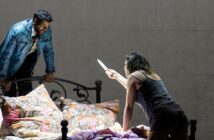
Misogyny is a recurring theme. After the primal video at the start, we are given several other versions of male attempts to control the women around them. Incel-in-training Alberich reacts to the Rheinmaidens rejecting him by seizing the figure of Erda from the video (dancer Jana Vrána) and taking her into the tree where it’s implied he rapes her. Later, in one of the most effective visual surprises, Alberich makes the Rheinmaidens reappear as idealized automatons—clearly the state he prefers them in as opposed to the lively, independent women who rejected him earlier. When the actual Erda appears late in the opera, she is now a more active, powerful figure in a red leotard, visibly with child as she makes her ominous prediction about the demise of the male-dominated rule of the gods.
Niebelheim, the subterranean realm where a race of dwarves is dominated by Alberich, is presented as a kind of security control room with three large video screens used to survey various locations, but also to mirror the stage action. This led to considerable visual overload, especially with the added presence of an onstage video technician. One of the characters (Loge?) tampers with the controls causing all three screens to break up until Alberich reconnects them. It’s just one example of an occasional excess of ideas that pulled visual focus away from the generally well-conceived concept.

Photo: Petr Neubert
The cast included a remarkable number of company members and guests making their role debuts. All eyes were on Adam Plachetka singing Wotan for the first time. The Czech bass-baritone is well-known to North American audiences for his many appearances at Metropolitan Opera, mainly in Mozart roles like Leporello and Figaro, and this Wotan certainly represents a big leap into a new repertoire. On the evidence here, the choice must be considered a complete success. In the gracious acoustic of this house, and with this sensitive orchestra, Plachetka soared with lyric tone that was generous and never forced. His characterization was well-conveyed and will undoubtedly deepen as he continues to explore this deeply-conflicted personality.
Baritone Joachim Goltz was outstanding as Alberich. He conveyed the character’s creepy misogyny with scary conviction and dominated the role’s considerable vocal demands. His curse of the gold stolen from him by Wotan made it clear he will be a force to be reckoned with as the saga unfolds.

Photo: Petr Neubert
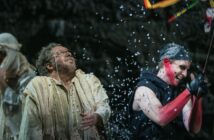
Veteran Czech tenor Štefan Margita has announced that this Loge represents his retirement from the opera stage. Here, the wily fire god acts as our host for the evening, à la the Emcee in Cabaret, with his pale makeup and black-lined lips. At various points he carries an old-time spotlight to emphasize his outsider, observer status. Margita struck an ironic, conspiratorial, tone that let us know he was under no illusions as to the flaws of the so-called gods.
As Wotan’s wife, Fricka, mezzo-soprano Tone Kummervold effectively conveyed her frustration with a wayward, roving husband. Soprano Alžběta Poláčková sang well as Freia, distaff chattel of the gods, but was saddled with a very unflattering costume which she bore with what dignity she could. As Erda, debuting Canadian mezzo-soprano Rose Naggar-Tremblay served notice with an extremely effective cameo, rounding out her famous “Weiche, Wotan, Weiche!” narrative with gorgeous, rich tone.
As Fasolt and Fafner, the giants who vie for Freia, both František Zahradníček and Zdeněk Plech had their effective moments although one might have wished for a bit more clarity of diction from the former which would have helped to focus his portrayal.
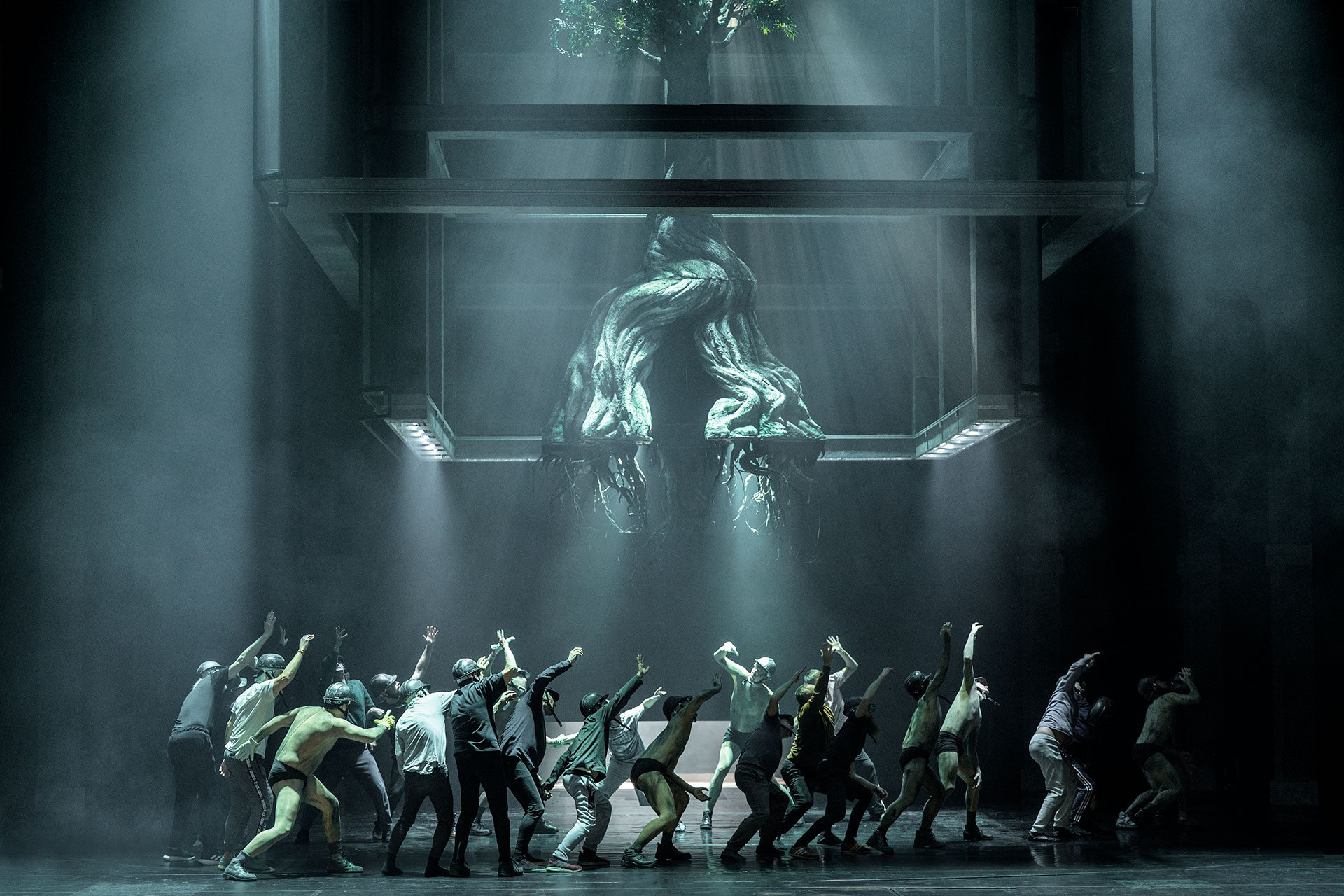
Photo: Petr Neubert
The company’s music director, Robert Jindra, led a dynamic performance. His orchestra offered a glorious entry of the gods into Valhalla at the opera’s conclusion but was also equal to the score’s more intimate passages. The National Theatre possesses an almost ideally clear acoustic which allows for big sound but simultaneously does not require singers to force.
Barring some unnecessary over-reliance on technology for its own sake, this was an intriguing take on what Wagner himself only viewed as a prelude to the bigger show yet to come. It will be intriguing to see where Daubnerová takes us as this Ring unfolds.
National Theatre’s new production of Wagner’s Das Rheingold continues its run through March 14.