This page is also available in / Cette page est également disponible en:
 Français (French)
According to his wife Alma, Gustav Mahler’s song, “Liebst du um Schönheit,” was “the only love song he ever wrote.” Shortly after Gustav and Alma’s wedding in March 1902, he wrote the piece and hid it in a score of Die Walküre, presenting it with the dedication “ein Privatissimum an Dich” (“a private treat for you”). A mention in the second verse to not love for youth was allegedly a justification for their relationship’s 19-year age gap.
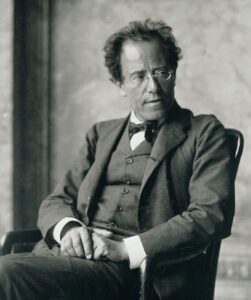
Photo: Moritz Nähr
He originally wrote the piece with piano accompaniment as part of his Rückert Lieder, but when he premiered the rest of the set with orchestra, “Liebst du um Schönheit” was not included, still reserved as a private piece just for Alma. In fact, Mahler never orchestrated the piece. It wasn’t until 1916 that Max Pullman, an editor at the C.F. Kahnt publishing company, did so.
The music
The orchestrated version is delicate and tender, starting with an oboe lead-in, and cycling through 2/4, 4/4, and 3/4 time signatures as it showcases Schönheit (“beauty”) in its simplicity. The piece quickly reveals a challenge that will follow the singer throughout the piece: in each strophe, the melody builds to a piano or pianissimo high note that then must be shaped to resolve and descend in the line.
The second strophe, on Jugend (“youth”), offers variation in tonality, while the third, on Schätze (“treasure”) is a repetition of the first. The music broadens and shifts tonalities again to affirm Liebe (“love”) and profess it with the almost playful descending lines of immer, immerdar (“forever, forevermore”). Mahler’s detail, and the opportunities for choices in the phrasing, diction, and dynamics, are endless.
Iconic recordings
Mezzo-soprano Janet Baker’s “Liebst du um Schönheit,” with the London Symphony Orchestra, is one of the most iconic recordings of the love song. Over the orchestra, Baker’s singing is easy and expressive, ideally caressing the final strophe.
For editions with piano, baritone Dietrich Fischer-Dieskau creates a beautiful partnership with pianist Daniel Barenboim. Fischer-Dieskau’s clarity of diction and dynamic shifts result in a gorgeously moving interpretation. Both of these two singers take a tempo that is a bit on the slow side, with plenty of rubato to really luxuriate in the love song.
Anne Sofie von Otter’s interpretation, with the NDR-Sinfonieorchester, is similarly strong in its communication, with even more delicacy than Baker and Fischer-Dieskau.
The text
The words are a bit tongue-in-cheek, as the love song actually starts with three different potential outs for the lover who is being spoken to. It is a somewhat cynical take on love, even though it ends by telling the lover to love them forevermore.
Clara Schumann
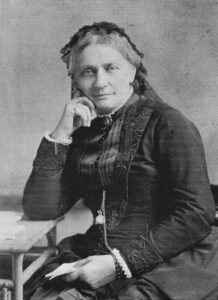
Photo: Elliott & Fry
The peculiarities of a love song that first attempts to push their lover away is what prompted me as an undergraduate to learn both the Mahler, and an alternate setting. Gustav and Alma Mahler were not the only musical couple enamoured by Rückert’s love poem.
In 1841, a year after their wedding, Robert and Clara Schumann wrote a collection of 12 Rückert poems, titled Liebesfrühling Lieder. “Liebst du um Schönheit” was set by Clara. In comparison to the Mahler, her strophic variations are more similar in rhythm and melody rather than offering complete tonal shifts. The melody is simpler, but the piano part is fuller. If Mahler seems to be intellectualizing the act of being in love, Schumann is more caught in its throes.
Liebst du um Schönheit,
O nicht mich liebe!
Liebe die Sonne,
Sie trägt ein goldnes Haar.
Liebst du um Jugend,
O nicht mich liebe!
Liebe den Frühling,
Der jung ist jedes Jahr.
Liebst du um Schätze,
O nicht mich liebe!
Liebe die Meerfrau,
Sie hat viel Perlen klar.
Liebst du um Liebe,
O ja, mich liebe!
Liebe mich immer,
Dich lieb’ ich immerdar.
If you love for beauty,
O do not love me!
Love the sun,
She wears golden hair.
If you love for youth,
O do not love me!
Love the spring,
Her youth is every year.
If you love for treasure,
O do not love me!
Love the mermaid,
She has many clear pearls.
If you love for love,
O yes, love me!
Love me always,
I love you forevermore.
This page is also available in / Cette page est également disponible en:
Français (French)