This page is also available in / Cette page est également disponible en:
 Français (French)
For the two semi-finals of the Aria section, the CMIM moved to the Maison symphonique. The first took place on June 3, with a lineup of five candidates. The hall’s different acoustics and the presence of the Montreal Symphony Orchestra behind them shed new light on their vocal qualities.
South Korean bass-baritone Chanhee Cho didn’t appear as forceful and dominant this time. While his voice carried well in Bourgie Hall, Cho now had to compete not with a piano, but with an entire orchestra. In “Why Do the Nations,” from Handel’s Messiah, his ornamentations were carefully executed, but they also resulted in him singing less loudly. It must be said that guest conductor Patrick Summers didn’t necessarily try to accommodate the singer by holding the orchestra back. This competition for volume was quite evident in “La calunnia” from The Barber of Seville. On the other hand, “Vous qui faites l’endormie,” an equally famous aria for bass, revealed that the performer was able to make his voice resonate better in soft passages, thanks to a greater richness of timbre, than in forte passages, where his voice seemed more restrained. A paradox, not only due to the lighter orchestral accompaniment…
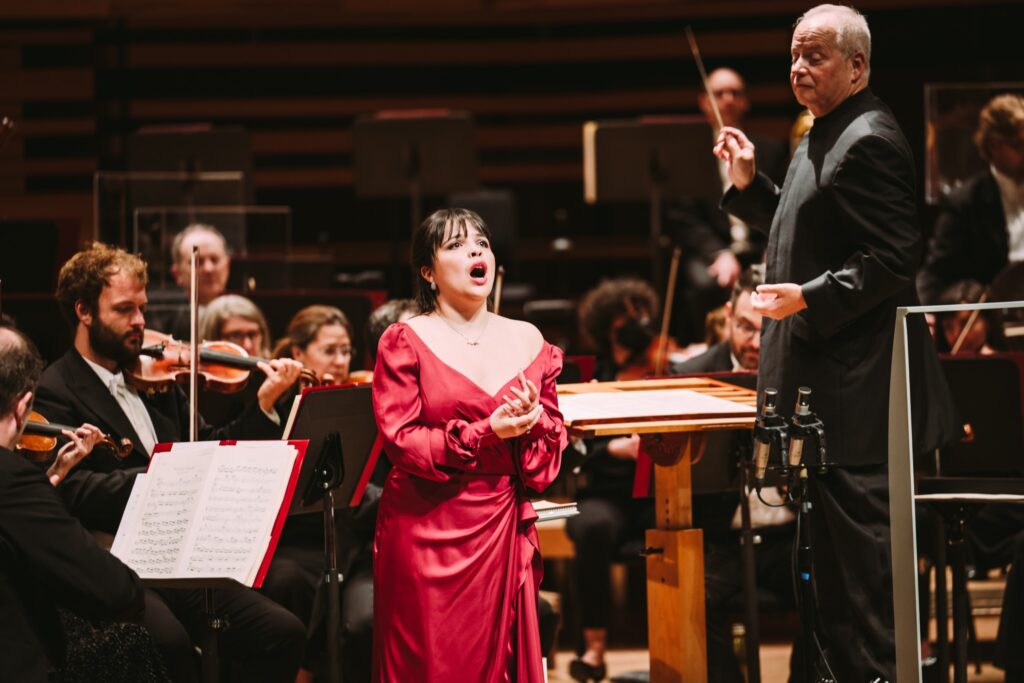
French soprano Fanny Soyer demonstrated excellent performance in the mid and upper registers, showcasing her virtuosity in the coloraturas of Mozart’s Exsultate, jubilate, despite a slight strain in one of the highest points of this sacred aria. However, her lower register lacked colour, even for a soprano. She offered other fine qualities in R. Strauss’s “Heimliche Aufforderung,” with very generous phrasing. Finally, in Stravinsky’s “No Word from Tom,” the singer was particularly touching and expressive, thanks in part to her enveloping voice, soaring easily above the orchestra. Her advancement to the final will be well-deserved.
South Korean tenor Junho Hwang was the evening’s strongest candidate. It would be very surprising if he didn’t continue his adventure at the CMIM. So impressive is his solid technique and artistic sense. Hwang was heartbreakingly moving in Tchaikovsky’s “Kuda, kuda.” An aria from Mendelssohn’s Elijah was an excellent second piece in his repertoire, demonstrating beautiful English and musicality that was as fluid and natural as ever. “Lunge da lei,” from La Traviata, concluded his semi-final performance in spectacular fashion. A real treat for the audience, which we hope will continue to grow.
The evening’s final two candidates, Chinese mezzo Jingjing Xu and American soprano Katerina Burton, delivered solid performances, but not as exciting as others in this competition. Xu failed to fully exploit her artistic and technical potential. As in the first rounds, she seems to be saving her voice for later, but in doing so, she risks elimination. This is not all bad. Her calm and restraint in “Près des remparts de Séville” from Carmen paradoxically offered an original interpretation, which is to her credit. On the other hand, “Können Tränen meiner Wangen,” from the St. Matthew Passion, made the orchestra stand out almost as much, if not more, than the singer. The highlight of Xu’s performance was Mozart’s “Parto, ma tu ben mio,” in which she displayed both virtuosity and commitment in a charming duet with OSM clarinetist Todd Cope.
For her part, Burton offered a fine presence and vivid moments of emotion in “Come in quest’ora bruna”, from Simon Boccanegra, but lacked the artistic stamp that set her apart from the other competitors
The second semifinal takes place tonight, June 4, at 7:30 p.m. at the Maison symphonique.
The CMIM Voice 2025 continues until June 6, 2025.
https://concoursmontreal.ca/en/voice-2025/
See Also : Spotlight on CMIM Voice 2025 from May 25 to June 6
ReWatch
This page is also available in / Cette page est également disponible en:
Français (French)