This page is also available in / Cette page est également disponible en:
 Français (French)
-
Bayerische Staatsoper Recordings4
Prokofiev: War and Peace
Olga Kulchynska (Natasha), Andrei Zhilikhovsky (Andrei), Arsen Soghomonyan (Pierre), Violeta Urmana (Marya Dmitriyevna Akhrosimova), Dmitry Ulyonov (Kutuzov), Arsen Soghomonyan (Bezukhov); Andrei Zhilikovsky (Bolkonsky); Victoria Karkacheva (Hélène); Olga Guryakova (Peronskaya), Bekhzod Davronov (Anatole), Christina Bock (Marya Bolkonskaya); Bayerische Staatsoper Orchestra and Chorus; Vladimir Jurowski, conductor; Dmitri Tcherniakov, director
Bayerische Staatsoper Recordings, 2025
Bayerische Staatsoper had planned its March 2023 production of Prokofiev’s War and Peace (and had likely contracted the small army of singers required) well before the 2022 Russian invasion of Ukraine. That event naturally provoked a rethink given that the opera is, in part, a rather crude piece of Russian nationalist/Stalinist propaganda and that both conductor (Vladimir Jurowski) and director (Dmitri Tcherniakov) are Russian, albeit vocal critics of the Putin regime.
Tcherniakov’s initial reaction was to pull out, but Jurowski felt the music made the piece still worth staging and persuaded the director to carry on. There’s a very long interview on the disc where the two men are interviewed on their thought process and what it led to. I would strongly advise anyone approaching this production to watch the interview ahead of the performance!
To summarize briefly, War and Peace is not a historically accurate piece. Neither is Tolstoy’s novel and the libretto (by Mira Mendelson-Prokofieva) is even less so. To quote Jurowski it’s Prokofiev’s “fake news” layered over Tolstoy’s “fairy tale for adults.” It has “absolutely nothing to do with reality.” The production isn’t “about” 1812 or 1941 or 2022.
So, what do we get? A large group of people are camped out in a reproduction of the Hall of Columns in Moscow. It’s an ornate ceremonial space that has seen Tsarist balls, trade union conferences, show trials and even fashion shows. The people are not (Tcherniakov insists) refugees but it’s unclear who they are supposed to be. What they represent is clearer. They are the Russian people, under threat of war and suffering from a kind of collective PTSD. It’s “a reflection of an alienated society” and what we are going to see is a “huge crowd in a dystopian setting” engaged in a “psychological experiment… with a bad ending.”
The opera opens with a nondescript guy taking his jacket off and starting to sing. It’s Andrei Bolkonsky. Soon we see two vivacious girls flitting through the camp beds; one in jeans, one in a dress. They are Natasha Rostova and Sonia. Why the people in the hall are playing out the plot of War and Peace is never really clear but the storytelling is obvious enough. The whole of Part 1 is play acting with a bit of an edge, but fairly “harmless.” The whole tenor changes after the interval.
The Epigraph has the stage filled with an increasingly aggressive crowd—almost a mob—singing grand patriotic music about the “Russian Soul” and “Defending the Motherland.” They start to paint Russian flags on their faces. This is followed by what is described (in projected text) as a “Military patriotic game: the battle of Borodino.” Men and women with toy guns rush around; there’s a kind of fake medical tent, and “refugees from Smolensk” are executed (not really). It’s quite disturbing but still clearly playacting. The German generals are made to look totally ridiculous. War is all about some indefinable Russian metaphysical quality embodied by Kutuzov, their commander-in-chief who leads the army against Napoleon.
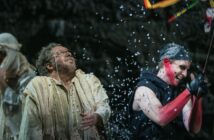
The episode with Napoleon and his staff officers is a ridiculous parody, with one of the officers getting “pied” while the onlookers laugh. The scene with the Russian generals is cut so it’s straight to Moscow during the French occupation. There’s real fighting breaking out and (I think) the execution of the “arsonists” is supposed to be for real. At least the “bodies” are carried off stage (unlike the Smolensk refugees who get up again after they are “shot”). It’s all a bit crazy. A frenzied dance party turns into a brawl and Bolkonsky shoots himself.
The Bolkonsky/Rostova reconciliation scene is played pretty straight and is quite moving but then it’s back to another brawl followed by Kutuzov being “enthroned” on a pile of battle trophies while an on-stage band plays a rather jolly tune.
Does it work? I think so. It certainly avoids glorifying Russia, Russian-ness or anything of the sort. It doesn’t trivialize war either. The people in the hall may have been traumatized to begin with, but they definitely get more degraded as matters proceed. The “great men”— Kutuzov and Napoleon—are made to look quite silly. The only characters who come off as somewhat attractive are Bolkonsky, Natasha and Pierre Bezukhov. The pettiness and viciousness of the circle around Hélène Bezukhova is clearly telegraphed. Above all, the ability of the “people” to degenerate into a vicious, unthinking, mob is made manifestly apparent.
There’s so much to unpack dramaturgically, that it’s almost possible to forget this is an opera with music and singing to be considered. But it is, and that side of things is very good. The singing from the principals, especially tenor Arsen Soghomonyan as Bezukhov and baritone Andrei Zhilikovsky as Bolkonsky, is powerful and characterful, and both are excellent actors. Olga Kulchynska, as Natasha Rostova, sings sweetly and is wonderfully vivacious. There are some excellent cameos among the rest of the huge cast, notably Violeta Urmana as an imposing Marya Dmitriyevna and Victoria Karkacheva as a rich toned and very elegant Princess Hélène Kuragina. Dmitry Ulyanov looks ridiculous as Kutuzov but he has a bass voice to reckon with.
Perhaps the real heroes throughout are the orchestra and, especially, the chorus. They throw themselves into the full spectrum of what they are called to do and sing beautifully. The orchestra plays magnificently. The orchestral music would make a terrific film score, it’s so vibrant and colourful. Jurowski reveals he is a master of this music and that he’s fully on-board with the production concept. It’s so important in a staging like this one that conductor and director are on the same page!
Maybe the last word on production intent though should go to singers Zhilikovsky and Kulchynska who make their bows in t-shirts with the Slava Ukraini logo prominently displayed.
The production was filmed at the Nationaltheater in Munich by Andy Sommer. It’s well done, with the many crowd scenes given enough space. Audio (PCM stereo and DTS-HD-MA) and video quality are well up to the standard expected of Blu-ray. The subtitle options are Russian, German, French, English, Japanese, Korean and most unusually, Ukrainian. Besides three and a half hours of opera, there’s a generous 50 minutes of extras on the disc: the aforementioned essential interview as well as rehearsal footage with useful commentary by the director. The booklet contains a track listing, a very useful scene by scene synopsis, and the transcript of a conversation with philosopher Boris Groys about Tolstoy’s view of history and its enduring influence in Russia.
This page is also available in / Cette page est également disponible en:
Français (French)