
This page is also available in / Cette page est également disponible en:
 Français (French)
On May 14, Orchestre symphonique de Montréal will perform the Prelude and Liebestod from Wagner’s Tristan and Isolde, an opera in which certain musical ideas recur, subtly shaping the drama as it unfolds. These so-called leitmotifs, especially prominent in these excerpts, are associated with characters, emotions or dramatic concepts that reappear throughout the score.
In Tristan and Isolde, these leitmotifs take many forms, ranging from the longing motif and the lovers’ call between Tristan and Isolde, to themes linked to individual characters such as Tristan or King Marke, as well as dramatic concepts such as the Daylight motif, which represents the world of social order and duty. Together, they guide the audience through the entire opera on a purely musical level.
More broadly, the use of leitmotifs was pioneered by Mozart and Berlioz, and became, through Wagner’s development, one of the most powerful tools of musical storytelling. In different scenes or contexts, it can suggest hidden connections between characters or foreshadow events yet to come. Music thus becomes an integral part of the narrative rather than simply an accompaniment to the visual drama.
The technique did not remain confined to opera. In the 20th century, it evolved into a central element of film music across a wide range of genres, taking on different functions depending on context.
In the action genre, a particularly well-known example of the leitmotif is the 1962 Bond theme, which functions as a character motif, musically defining James Bond while underscoring his composure and determination.
By contrast, the romance genre shifts the focus to emotional relationships between characters. For example, in the Oscar-winning film La La Land (2016), “Mia & Sebastian’s Theme” serves as a melancholic piano motif that brings their connection to life musically and reflects the bittersweet tension between two people who love each other but must ultimately part ways; it is heard in key scenes such as the planetarium sequence and in the concluding epilogue, which imagines an alternative version of their relationship.
The adventure genre focuses more on heroic moments: the “Raiders March” from the Indiana Jones film series (beginning in 1981) typically plays when the protagonist performs a heroic deed or “saves the day.”
In fantasy films, leitmotifs often extend to entire places. In The Lord of the Rings (2001–2003), every major location is given its own musical theme, such as the gentle melody of the Shire, the mystical sounds of Rivendell, the heroic strains of Rohan, or the ominous sounds of Mordor.

Photo: Universal Pictures
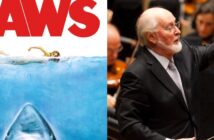
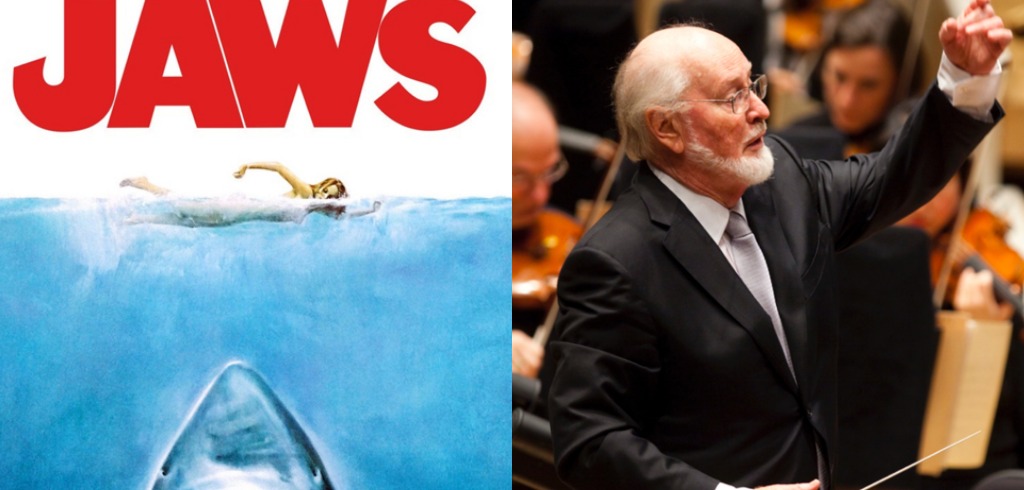
Lastly, the horror/ thriller genre can also demonstrate just how effective leitmotifs are in their simplest form. This is particularly evident in the “Shark Theme” from Jaws, which shows how just two notes are enough to create strong recognition and intense suspense, signaling the shark’s presence long before it appears on screen. Nearly 50 years after the film’s release, this motif remains instantly recognizable today, like other examples mentioned above. Because the shark is often unseen, the music itself becomes a warning. In this way, the leitmotif does not merely accompany the action but actively shapes the viewer’s experience of suspense.
Similar techniques can be heard in many other film scores by John Williams. In Star Wars, characters and ideas are associated with distinct musical themes, from the ominous “Imperial March,” linked to Darth Vader, to the lyrical “Force Theme,” which represents the mystical power at the heart of the story. Throughout the Harry Potter films, “Hedwig’s Theme” functions as a musical emblem of the magical world itself. The broad, soaring theme of Jurassic Park, meanwhile, evokes the sense of wonder surrounding the revived dinosaurs.
The leitmotifs in these films create a musical framework that guides the audience through the visual experience. Characters, ideas and even entire worlds are given distinct musical identities, allowing listeners to follow the emotional and dramatic development of the story. Yet these themes are rarely static, often returning in new orchestrations or harmonic settings. Much of their effectiveness is closely tied to the way film composers write for the orchestra.
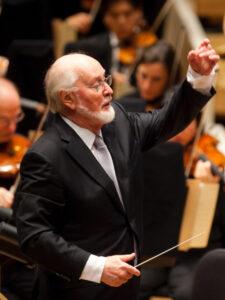
Photo: Todd Rosenberg Photography
In fact, John Williams’s musical language is deeply rooted in the symphonic tradition, an influence that helps explain the close connection between his film music and operatic techniques such as the leitmotif. Central to this sound is Williams’s orchestration. Powerful brass sections, sweeping string melodies and rich harmonic textures give film music much of its emotional force. In many cases, the sound world of modern film scores closely resembles that of 19th-century Romantic orchestral music. This relationship between classical tradition and film music is part of what gives the work of composers like Williams its enduring resonance.
Today, this connection is increasingly visible in the concert hall. Film scores are regularly performed by orchestras around the world, and “live-to-picture” screenings, where films are projected while the score is performed by a full orchestra, have become especially popular. As discussed in our previous column on film concerts and screenings (“Music and Film Together Again Onstage”), these performances bring film and orchestra together in a unique concert experience that highlights the close ties between film music and the symphonic tradition.
This page is also available in / Cette page est également disponible en:
Français (French)