This page is also available in / Cette page est également disponible en:
 Français (French)
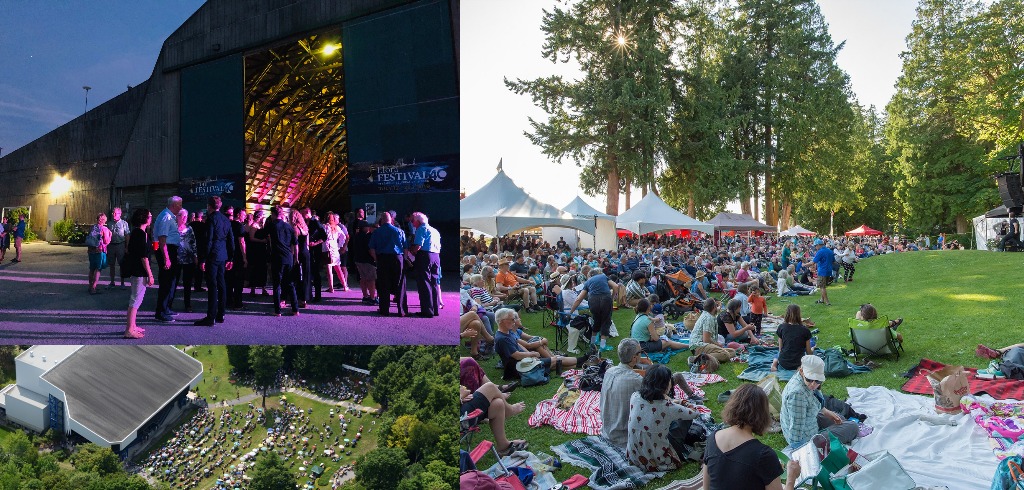
As summer festival season fast approaches, towns across Canada are gearing up for an influx of music-loving visitors. Music festivals offer something special to the community, fostering unique impacts on local culture and economy. From bucolic Lanaudière (north of Montreal) to quaint Elora in southern Ontario, one thing’s for sure: the relationship between festivals and small towns is mutually beneficial.
These festivals serve as cultural landmarks that play a key role in shaping the towns’ identities. “I’ve been kind of blown away at the extent to which the festival is integral to the cultural identity of Dawson City; people take a lot of pride in it,” says Corbin Murdoch, executive director of Dawson City Music Festival, the Yukon’s longest-running festival.
Elora Festival’s Artistic Director Mark Vuorinen makes a similar point, noting that “Elora is a very vibrant, close-knit community that helps support the festival and operations that we have.” Residents are proud to be involved with such significant cultural events.
Conversely, towns are equally influential in shaping their festivals. Many of their locations are bursting at the seams with character, and contribute a rich and vibrant history. Vuorinen believes that location is key to his festival’s identity. The experience of visiting a small town is part of the appeal in and of itself. “You get kind of dropped into a little European village, you know, in some ways, because Elora’s got that real historic core that brings a lot of people in,” he says.
Arthur Arnold, artistic director of Powell River’s Prisma Festival, lights up as he speaks about the town. A conductor who has spent much of his career in Europe, Arnold fell in love with the small B.C. coastal town and now calls it home for half of the year. “Powell River is an incredible geographical place where I would say the mountains kiss the ocean and that’s where it happens.”
Festival de Lanaudière is rooted in the region’s rich history of the arts, as Executive Director Clément Joubert emphasizes. “The fathers of the classical theatre created a school here many years ago. So some fathers were really into music, and then they created a summer camp, a festival, a competition, a school. This explains why the music here in this region is so rich. It has very deep roots.”
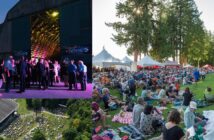
Each of these towns presents its own opportunities. Lanaudière is a region filled with unique cultural destinations. Joubert mentions Hors les Murs, their eclectic series of concerts hosted in different locations, from a lavender farm in the north of the region to a distillery “in the shed where all their barrels are stored, so you can smell the wood and the alcohol. There’s alcohol tastings offered as well.” These atypical destinations are part of Lanaudière’s appeal.
One of Vuorinen’s primary focuses at Elora has been experiential concerts like Music in the Woods, during which “audience members are taken on a 45-minute hike where they encounter music along the way.” Site-specific concerts are also part of Prisma Festival where the final performance, Prisma on the Beach, is a free open-air show with food vendors. It’s just one way festivals often can offer new ways of experiencing and appreciating music.
Many festivals have a mandate to uplift the communities in which they are based. Prisma’s Arnold mentions the construction of an arts hub for Powell River—a project currently underway, spearheaded by the team at Prisma. This hub will offer office space to various arts organizations, rehearsal spaces, and a performance hall. Arnold reflects on the progression of the arts scene in Powell River: “I mean, I started Prisma in a basement, and now we have a symphony orchestra in Powell River … that started because of Prisma.” In just 13 years, Arnold has nurtured Powell River’s arts scene; he has been welcomed with open arms and the community has flourished.
One of the most significant markers of a festival’s success is its economic impact. Vuorinen emphasizes that the festival brought in an estimated $1.2 million to Elora in 2024. For these small towns, festivals are destination events, which leads to an influx in tourism.
“People come to Powell River from all over the world—from the States, from Europe—and they book their hotels early. Of course, it’s good for our local economy,” says Arnold. Prisma generates more than $1.6 million for Powell River with a 2.05 multiplier effect, according to Arnold. Festival de Lanaudière draws in crowds that benefit local businesses in Joliette, and the Elora Festival similarly attracts visitors whose spending supports local shops, accommodations, and restaurants.
The continued success of all these festivals generates dependable local economic activity. Beyond showcasing the arts, festivals help to invigorate vibrant culture, economic growth, and social connection in the towns where they are situated. “I say this to the audience, too: It is us that do that. It’s not just me or our team. It’s really us as a community. We do this together,” says Arnold. In small towns in particular, a festival’s roots are in the community. It is a reciprocal relationship.
www.prismafestival.com; www.elorafestival.ca; www.lanaudiere.org
This page is also available in / Cette page est également disponible en:
Français (French)