
This page is also available in / Cette page est également disponible en:
 Français (French)
-
Wergo4
Aribert Reimann: Ein Traumspiel; Denn Bleiben ist nirgends
Franziska Rabl, mezzo-soprano; Karsten Jesgarz, tenor; James Tolksdorf, baritone; Marek Reichert, baritone; Opernchor Theater Hof; Hofer Symphoniker; Walter E. Gugerbauer, conductor; Martin Engler: narrator; Deutsches Symphonie-Orchester Berlin; Manuel Nawri, conductor
Wergo, 2026
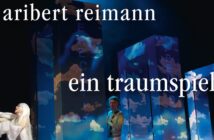
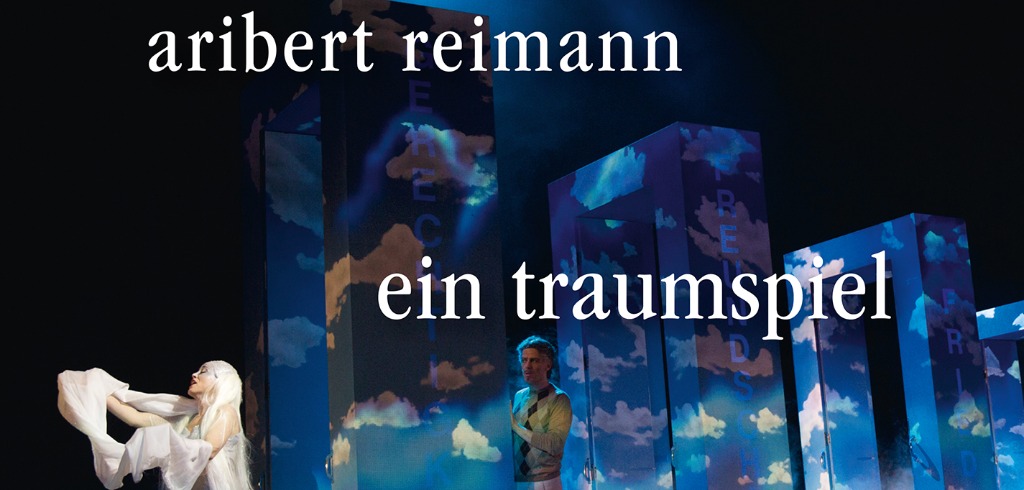
Ein Traumspiel was Aribert Reimann‘s first opera. It premiered in 1965 in Kiel. It is based on Strindberg’s Ett drömspel (A Dream Play), which is a pretty weird piece, and musically, it’s heavily influenced by Alban Berg. Since the premiere, the piece has had two productions in Germany—at Wiesbaden in 1987 and, of all unlikely places, in 2018 in the small city of Hof near the Czech border, where it was recorded. That recording has now been released on CD.
The libretto is a condensation of Strindberg’s 1901 play by soprano Carla Henius and the composer. It cuts out a number of subplots and quite a few characters (the Strindberg has 40!) to create a story that is, in outline, simple enough. The god Indra, puzzled because all he ever hears from humans are complaints, sends his daughter to investigate. She observes and experiences all sorts of human misery before her apotheosis in the burning remains of the castle where the piece opens.
The complication is that it’s a dream (dreams are “not real but more than real”) which allows for the incorporation of various elements of surrealism and expressionism. The castle grows. There are two odd scenes in Fingal’s Cave, which seems to function as Indra’s ear. And, of course, neither time nor space are linear or consistent; scenes repeat, characters make impossible journeys and so on. Some characters are really just representations of an abstract idea.
But along the way, the daughter sees—and even undergoes—the pain of human existence. A singer’s contract doesn’t get renewed. The Lawyer is refused his doctorate. The Officer never gets to marry the mysterious Viktoria who is located in a theatre where the door cannot be opened. The daughter herself is trapped in an unhappy marriage. Christ appears walking on the ocean, which terrifies a ship’s crew. Finally, the daughter, having learned that human life is pain and suffering, leaves with the words “Oh, jetzt weiß ich wie es ist Mensch zu sein – leb wohl!” (“Oh, now I know what it’s like to be human – farewell!”). It’s a procession of semi-related scenes, as you might expect in a dream.
Musically, it’s reminiscent of Alban Berg’s Wozzeck. The dramatic scenes—13 of them plus a prologue—are mostly separated by orchestral passages; sometimes the curtain comes down, sometimes it doesn’t. The musical structure is quite formalist. The arrangement of pitch is consistently serial, though other structures/techniques are used for other elements. The booklet explains this in great detail. Unlike Berg, sometimes characters switch from song to speech. Overall, the sound world is remarkably like Wozzeck, though the drama is very different.
Theater Hof managed to assemble a pretty good cast. The star is mezzo-soprano Franziska Rabl, who plays the daughter. She is on stage for almost the entire 1¾ hours and doesn’t flag. It’s an interesting voice, too; quite mature without being particularly smokey.
Other key performers include tenor Karsten Jesgarz as the Officer, bass Daniel Milos as the Glazier and baritone James Tolksdorf as the Lawyer. They all acquit themselves well, as do the further 12 soloists who manage 19 parts between them. The Opernchor des Theaters Hof and the Hofer Symphoniker are very decent too. Walter E. Gugebauer conducts. It’s really remarkable that the municipal theatre in a rather remote town of 45,000 souls could put on a very effective production of such a challenging work.
The recording was made at a live stage performance on March 17, 2018. The orchestra is captured extremely well. So, for the most part, are the voices—though there are a couple of places where the acoustic changes rather abruptly as characters move about. It’s released as a physical 2CD set, as MP3 and as lossless 44.1kHz/16bit (my review copy) or 48kHz/24bit. There’s a very comprehensive and excellent booklet with full text and translation.
There’s also a bonus. The album includes a recording of Reimann’s 1968 work Denn Bleiben ist nirgends (To be staying is nowhere). This is a setting of Rainer Maria Rilke’s Erste Duineser Elegie which is spoken over an orchestral accompaniment. Here, the musical technique is quite different, with essentially a series of experiments with “surfaces” and a metrical notation of the composer’s devising. It, too, is explained in detail in the booklet. The effect is of a kind of low-level background that comes and goes, into which defined groups of instruments make “eruptions.” Short, mostly atonal, passages build and then die away. It’s really quite interesting.
The 20-minute piece features Martin Engler as the speaker along with Deutsches Symponie-Orchester Berlin under conductor Manuel Nawri. It was recorded at Berlin’s Jesus-Christus-Kirche in Berlin on April 1, 2014, and it’s a very decent recording.
So, two very interesting early works by one of Germany’s most important composers of the last 80 years are now available on CD. An important release.
This page is also available in / Cette page est également disponible en:
Français (French)