Czech composer Bedřich Smetana, most famous for his comic “folk” opera, The Bartered Bride (Prodaná nevěsta), culled from the myth-shrouded annals of Czech history the material for his only foray into tragic opera, Dalibor. The result is a lush, melodic late Romantic tale of knights, vendettas, heroic resistance, chivalric romance, and – most centrally – male bonding that reaches beyond the grave.
And as this year’s featured opera highlight at Bard College’s 2025 SummerScape festival (Annandale-on-Hudson, New York), Dalibor is being accorded what appears to be its historic first-ever fully-staged professional production in America.

by Bedřich Smetana; Bard SummerScape 2025; photo by Maria Baranova
Czech-ered Past…
Premiering in Prague in 1868, the opera was not an instant success, criticism centering in large part on Smetana’s eschewing of folk music inflections this time around, instead offering a grand through-composed score with a rich mix of soaring arias, duets, and expansive stretches of purely orchestral quasi-symphonic music. Regarded originally as too “Wagnerian,” the piece underwent subsequent re-evaluation and, with a major revival in 1886 (sadly, after Smetana’s death) was adopted as a cultural standard and rallying cry by a new Czech nationalist movement. It has retained its esteem ever since.
A Knight’s Tale
Dalibor’s elaborate backstory is efficiently handled upfront by the opera’s libretto (originally in German by Josef Wenzig and then translated by Ervín Špindler for the supervening Czech version).
The knight Dalibor, a champion of the people, has been imprisoned for killing the local burgrave (castle noble) in revenge for the burgrave’s having killed Dalibor’s own beloved companion, the musician Zdeněk.

by Bedřich Smetana; Bard SummerScape 2025; photo by Maria Baranova
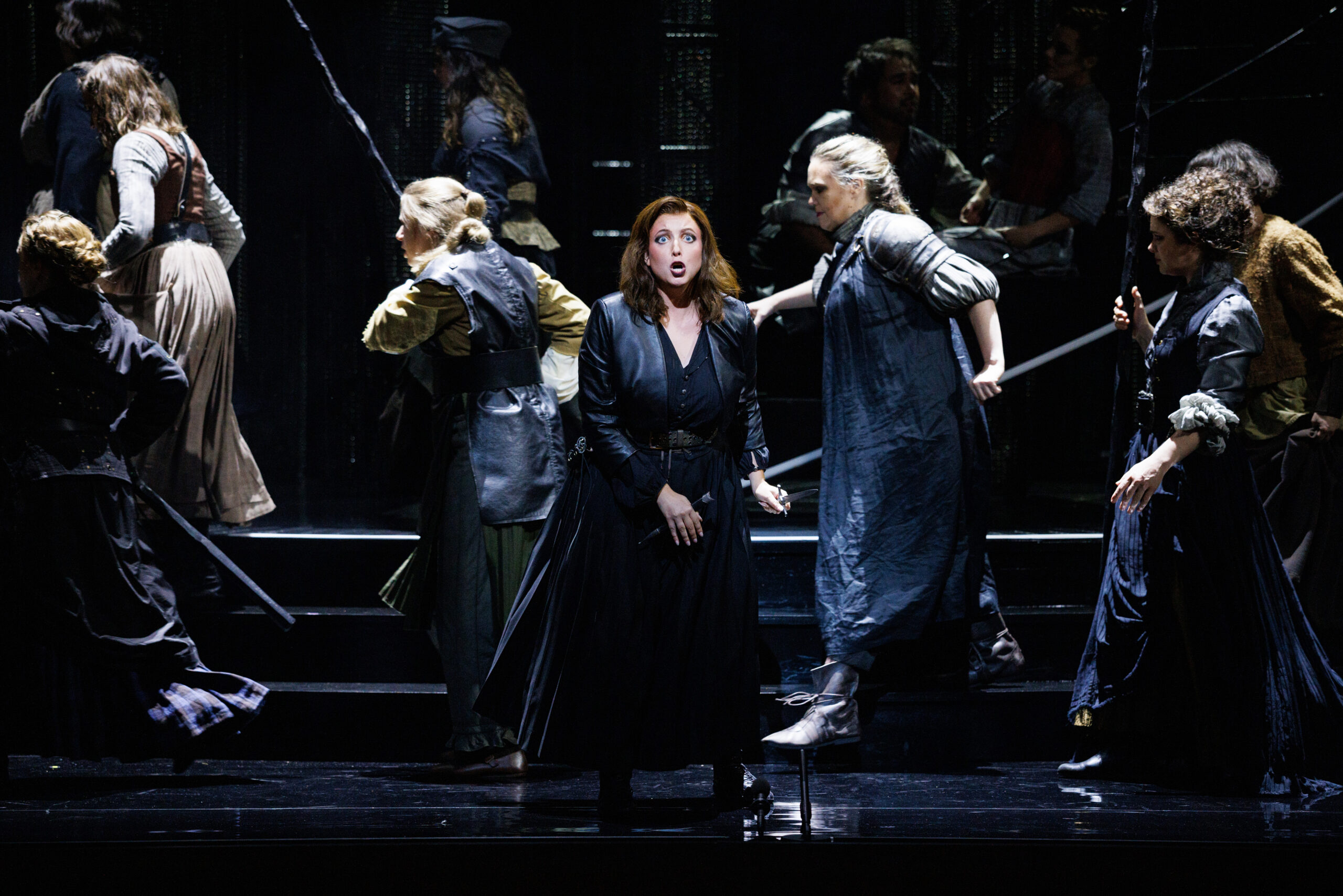
The burgrave’s sister, Milada, has led the cry for justice and vengeance. But, upon beholding Dalibor for the first time in the dock, she falls instantly in love with him, and on a dime determines to engage in any exploits necessary to free him, even venturing so far as to infiltrate Dalibor’s prison dressed as a boy and ingratiate herself with the lonely and fatuous jailor.
Remarkably, upon donning trousers, Milada comes off as a dead ringer for Dalibor’s beloved Zdeněk – a virtuoso violinist and boon companion of the bosom who continues to haunt Dalibor’s bereft and captive heart even in death. (A violin, incidentally, becomes a significant device as the action unfolds.)
Three on a Match
The emotional geometry of Dalibor thus turns on an intriguing ménage à trois – the imprisoned Dalibor, the newly smitten Milada, and the deceased Zdeněk.

Such heroic devotion between warrior lovers is, of course, of a piece with many such relationships memorialized in epic literature. Think Gilgamesh and the doomed Enkidu; the anguished Achilles and his fallen Patroclus; or the biblically attested love of David for the slain Jonathan (“Your love for me was wonderful, / more wonderful than that of women”).
Dr. Leon Botstein, president of Bard and music director of SummerScape, remarks that Dalibor is “perhaps the only opera in which the central character never sings a note.” Actually, the opera’s original cast list doesn’t call for the character of Zdeněk to appear at all. It is therefore an ingenious innovation of this production (though one that seems almost unavoidable in hindsight) that the dead object of affection should be conjured not just through the opera’s lyrics, but in full form, portrayed by a non-singing actor who inhabits the world of Dalibor as dream, or perhaps memory. Or perhaps as an actual ghost.

by Bedřich Smetana; Bard SummerScape 2025; photo by Maria Baranova
Czech-ing all the Boxes
The performers of this SummerScape production of Dalibor are uniformly outstanding, and the clarity and conviction of the work is all the more impressive for its being sung in the original Czech, despite none of the cast being native speakers.
Soprano Erica Petrocelli as Jitka, the orphaned girl whom Dalibor has reared as his ward, brings a tough and resilient swagger to the role along with a bright, powerful voice.
Soprano Cadie J. Bryan as Milada, Dalibor’s lover and would-be liberator, manages the dramatically challenging transition from avenger to inamorata with dramatic commitment, impressive vocal versatility and great physical grace.

Tenor John Matthew Myers plays the opera’s title character with valiant stolidity and a voice of thrilling ring, squillo and heroic power.
Other standout performances are provided by bass-baritone Alfred Walker as the King; baritone Eric Greene as the stalwart commander of the guard; tenor Terrence Chin-Loy as Dalibor’s mercenary ally, Vitek; and, quite impressively, the opulent-voiced bass Wei Wu as the comic-dramatic jailor, Beneš – a performance of ceaselessly intriguing and well-observed character detail.
Finally, actor Patrick Andrews rates commendation for his haunting, decorous, ethereal contribution as the silent Zdeněk, traversing the action to spooky and ultimately ennobling effect.
Leon Botstein conducts the excellent American Symphony Orchestra’s performance of Dalibor with utter authority and refined nuance, while director Jean-Romain Vesperini has crafted elegant physical life in his staging, both in the large ensemble segments and the more intimate interactions among the principals.
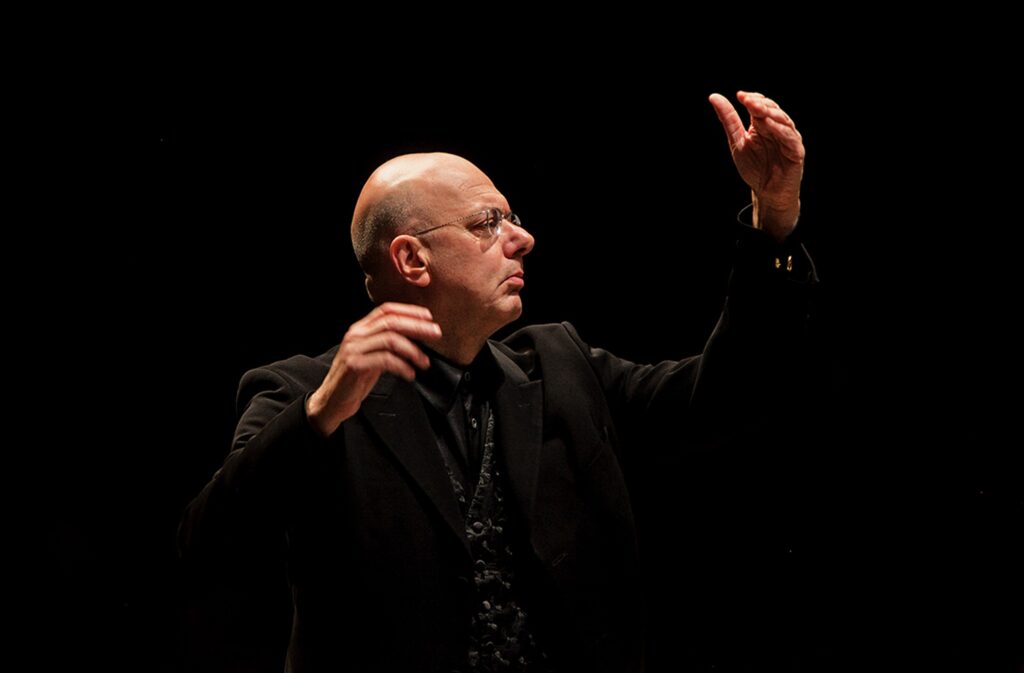
Conductor, the American Symphony Orchestra
The noirish silver-grey designs of the set, lighting, and projections – by Bruno de Lavenère, Christophe Chaupin, and Étienne Guiol, respectively – are handsome and evocative. A large central helix of stairways rotates slowly and subtly, suggestive perhaps of the inexorable grindings of fate, while it occasionally takes on a warm golden-bronze glow in accompaniment to characters’ rare respite in dream or in a lover’s embrace, while shimmering curtains of fine chain mail support ghostly, ever-shifting fuliginous projected images.
Kudos, too, go to the Bard Festival Chorale, who are just as expressive, cohesive and vocally crystalline as ever under the guidance of the festival’s longtime chorus master James Bagwell.
Dalibor was viewed on Sunday, July 27, 2015; it also played on Wednesday, July 30, 2025; and, as of this writing, will perform twice more: on Friday, August 1, 2025 at 4 pm and on Sunday, August 3, 2025 at 2 pm at the Fisher Center at Bard. Additional information, tickets and reservations for live stream viewing may be had at https://fishercenter.bard.edu/events/dalibor/