John Cranko’s Onegin has played an important role in the recent history of the Hungarian State Ballet. Its current artistic director, Tamás Solymosi, danced the title role in the ballet’s 2002 company premiere. He has been key to keeping the work in its repertoire, including overseeing a new 2012 production by Thomas Mika. On March 3, Cranko’s masterpiece pulled all of its emotional punches in an extremely well-cast revival.
While on the surface Cranko’s choreography draws almost entirely on traditional ballet vocabulary, its modernism stems from the manner in which each step and gesture are intrinsically married to character and narrative. In Onegin, the title character’s slow, deliberate traversals of the stage immediately convey his egoistic reserve while Tatiana’s ecstatically arched lifts signal her naïve, romantic notions about love based in fiction.
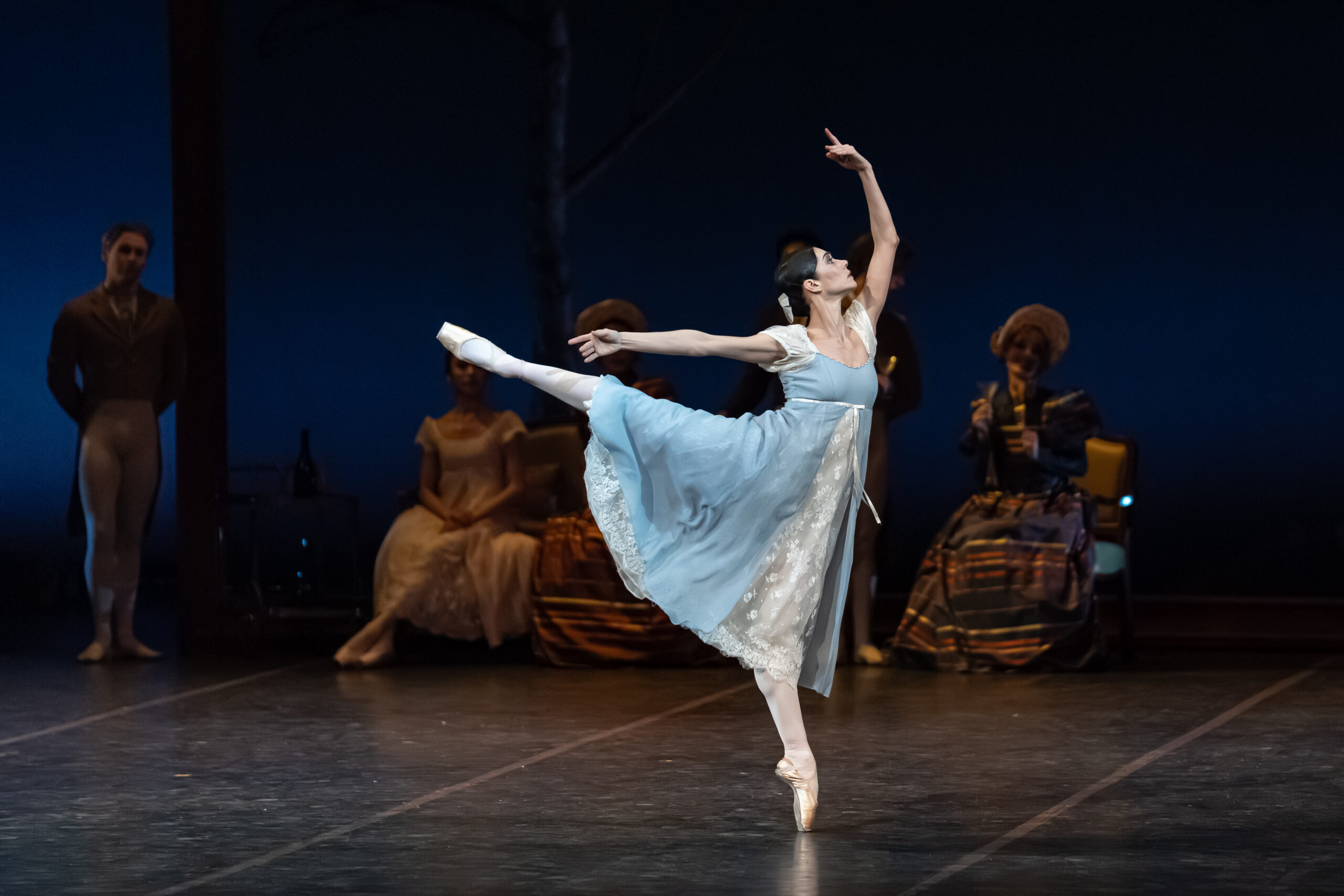
Photo: Valter Berecz / Hungarian State Opera
Mika’s costumes are solidly placed in the period of Alexander Pushkin’s early 19th-century verse novel. His sets are sparse, but effectively convey atmosphere and place. Act 3’s grand ballroom is indicated by carefully-placed chandeliers, and Tatiana’s family estate by silhouetted trees. It’s deceptively simple, and the perfect receptacle for Cranko’s striking, character-based movement.
Ultimately, this concentrated narrative comes down to four characters. You therefore need dancers who can express their rich inner worlds, clearly and convincingly. The dramatic travails of the central quartet of Onegin, Tatiana, Lensky and Olga were conveyed with impressive specificity.
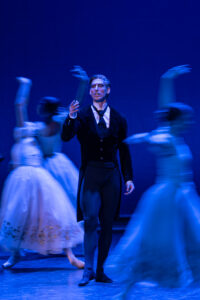
Photo: Valter Berecz / Hungarian State Opera
In the title role, Gergő Ármin Balázsi struck an ideal balance between imperiousness, feigned interest and ultimate devastation. Some Onegins can overdo the standoffishness, but Balázsi was careful to include some (insincere) playfulness when he dances with Olga to make his friend Lensky jealous. Likewise, in the dream sequence in Tatiana’s bedroom where she imagines dancing with an idealized version of Onegin, he exhibited believable passion. In his opening solo, even while executing clean pirouettes and jetés, Balázsi still managed to convey his character’s ennui and disinterest in the attentions of lovelorn, teenaged Tatiana. He used his advantageous height and strength to great advantage in the many complex lifts.
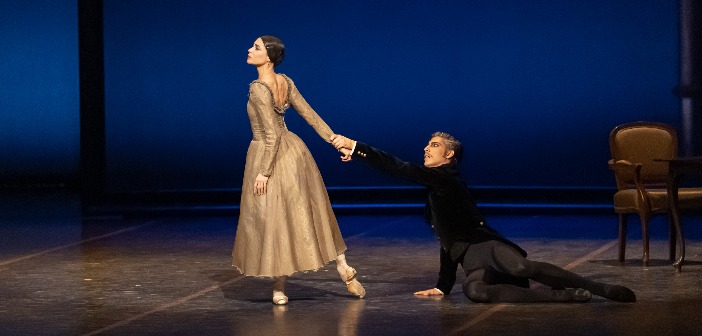
Maria Yakovleva was believable as the young, naive Tatiana. She demonstrated just the right degree of bookishness and naivete in the early scenes when she first meets Onegin and falls immediately in love. In the famous letter scene pas de deux, Yakovleva demonstrated complete trust in her partner. She threw herself into Balázsi’s arms with abandon as he lifted her into extremely complex architectural poses. Her struggle to resist was palpable when Onegin returns many years later in the final scene, realizing he has loved her all along. Her brutal resolve was brilliantly signaled in one of Cranko’s greatest moments as Tatiana drags the prone Onegin across the stage behind her.
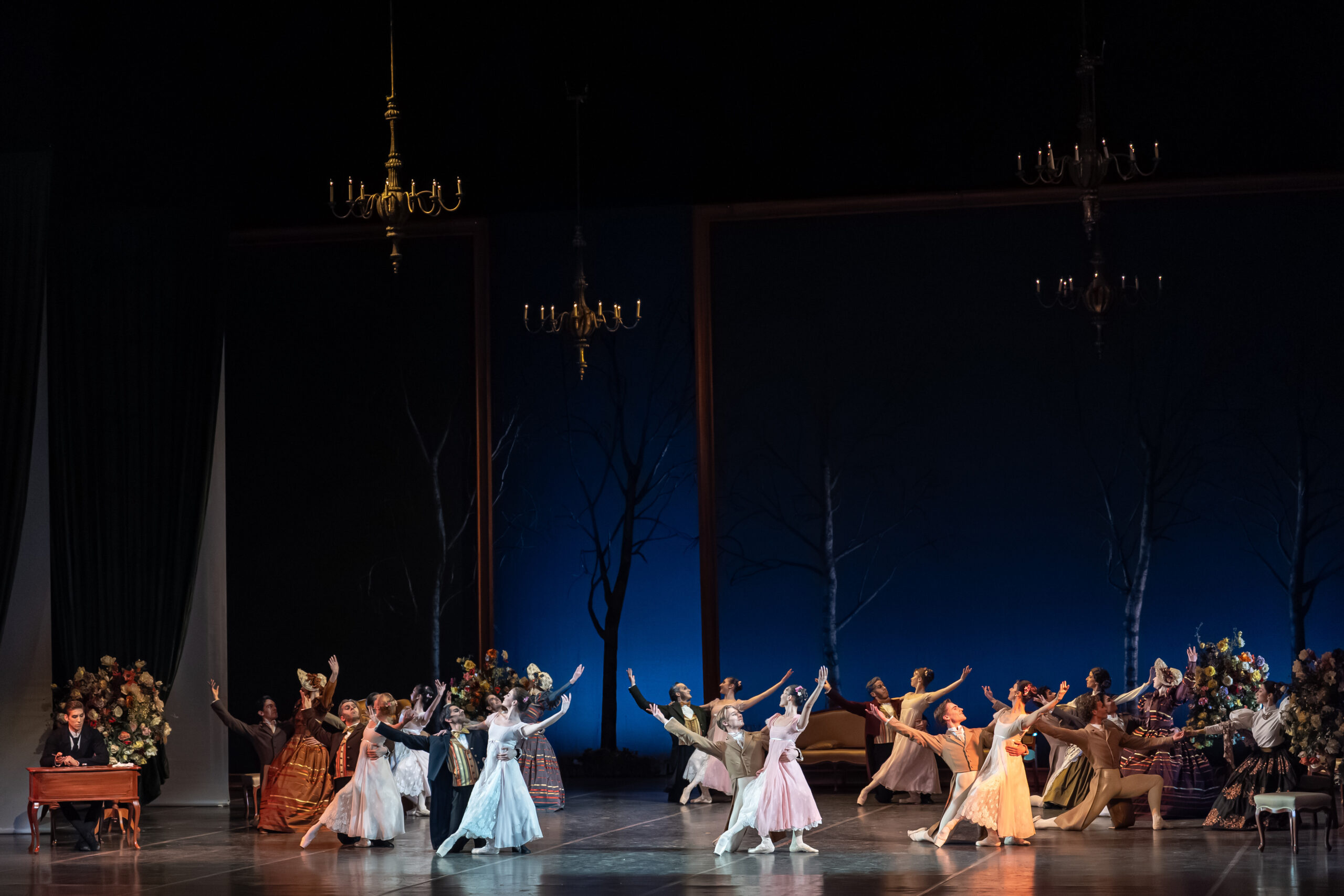
Photo: Valter Berecz / Hungarian State Opera
In Onegin, the so-called ‘secondary’ couple is in fact of integral importance. Lensky, Onegin’s friend and the object of Olga’s (Tatiana’s sister) love, functions as the title character’s opposite, free and open in his affection until cruelly goaded into a duel by his erstwhile friend who flirts outrageously with Olga. The role offers gorgeous, lyrical solos on which Viachaslau Hnedchyk imprinted his personal stamp. He was especially impressive with his smoothly-executed arabesque turns in the moving solo before the duel.
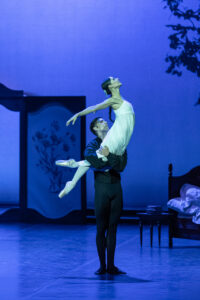
Photo: Valter Berecz / Hungarian State Opera
As Olga, Yuki Wakabayashi projected carefree love until forced to plead desperately with Lensky to abandon the duel. Cranko brilliantly conveys the horror of this situation with a series of angular poses in which her body is folded together with Lensky’s and Tatiana’s. Wakabayashi offered a sylph-like portrayal, weightless in her lifts, with beautiful extension à la seconde in her Act 1 pas de deux.
As Prince Gremin, the slightly older nobleman with whom Tatiana settles into a loving marriage, Luca Massara was a firm presence, partnering Yakovleva sensitively in their final act pas de deux.
The company’s corps was especially thrilling in the Act 1 jetés en diagonale as repeated rows of women leap across the stage, supported by the male corps. This talented group continues to impress with their synchronization and individually strong dancing. The entrance of several male corps in Act 1 with their huge leaps and flips was an unexpected thrill.
The orchestra, under ballet specialist Paul Connelly, revelled in the gorgeous sonorities of the pastiche Tchaikovsky score. This late winter revival had no sense of routine hanging about it. It showed once again why this company has become one of the strongest presenters of traditional and contemporary ballet in Europe.
For more on Hungarian State Ballet’s season, visit www.opera.hu/en