Musikfest Berlin went into its final week with the Berlin Philharmonic returning on Sept. 17, this time under their chief conductor Kirill Petrenko, for two mid-century works and a romantic chestnut. North American orchestras have a penchant for world premieres, something the festival also shares, but they are less likely to program no-longer-new 20th and 21st-century works, especially by European composers.
The Berlin Phil helped to remedy this imbalance with Pascal Dusapin’s Exeo (Latin for “I go beyond”), the fifth of his seven Solos for Orchestra (2002). Its thick, heavy textures create large swathes of colour, heavy on brass, which occasionally drops out to leave just the strings. The piece is a continuous wave linked by long, sustained string tones. The horizontal movement is interrupted by violent string attacca, then the piece resolves quietly, with a smattering of low bass and high violin.
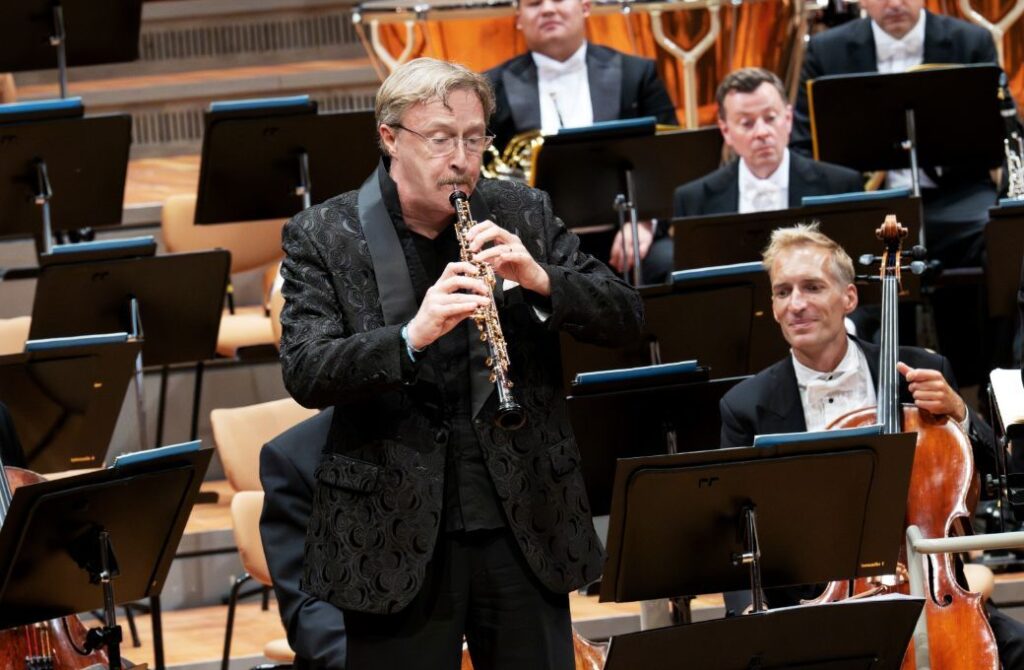
Bernd Alois Zimmermann’s Concert for oboe and small orchestra (1952) exemplifies the Cologne-born composer’s eclecticism. Albrecht Meyer, the orchestra’s principal oboe, managed the first movement’s trills and dancelike baroque rhythms in true virtuoso fashion. The more lyrical second movement found Meyer in duet with the celesta while the finale sticks to concerto convention with an exciting cadenza which had the oboist tossing off fast runs and more trills.
For an encore, Meyer was joined by concertmaster Noah Bendix-Balgley for a sublime Bach duet, supported by other orchestra members as the back-up continuo band. The two soloists clearly relished the chance to play chamber music together.
Petrenko led a gutsy traversal of Brahms Symphony No. 1 (1855-76) in the second half. His efficient, contained gestures were still able to draw maximum expressiveness from his forces. I suspect a lot is conveyed via facial expression, often revealed in a big grin when he is in profile. Bendix-Balgley was at the forefront again playing breathtakingly beautiful solos in the second movement. The subsequent allegretto was fleet, light and pastoral, as informed by Petrenko’s impish demeanour. That movement’s ‘big tune’ was far from lugubrious, played with a transparent texture more akin to Beethoven.
Without a doubt, one of Musikfest’s main events was the world premiere of American composer Marc Blitzstein’s one-act opera Parabola and Circula (1929/30) by Sweden’s Norrköping Symphony Orchestra on Sept. 21. Billed as the world’s only Cubist opera, its planned premiere with the Bauhaus in Dessau never came to be. Inspired by the composer’s interest in constructivist art, the opera is set in a land of abstract forms. Its protagonists embody geometric forms: Parabola loves Circula; their children are Rectangula and Intersecta and they have friends called Prism, Line and Geodesy.
The plot revolves around the notion that love takes away one’s independence and oppresses the spirit of modernity. Parabola’s doubt causes a black projectile to kill Circula. Blitzstein is probably best known for his wonderful songs in the Weill/Broadway vein. Here, the musical language is conventional, seemingly at odds with the modernist subject and Bauhaus context.
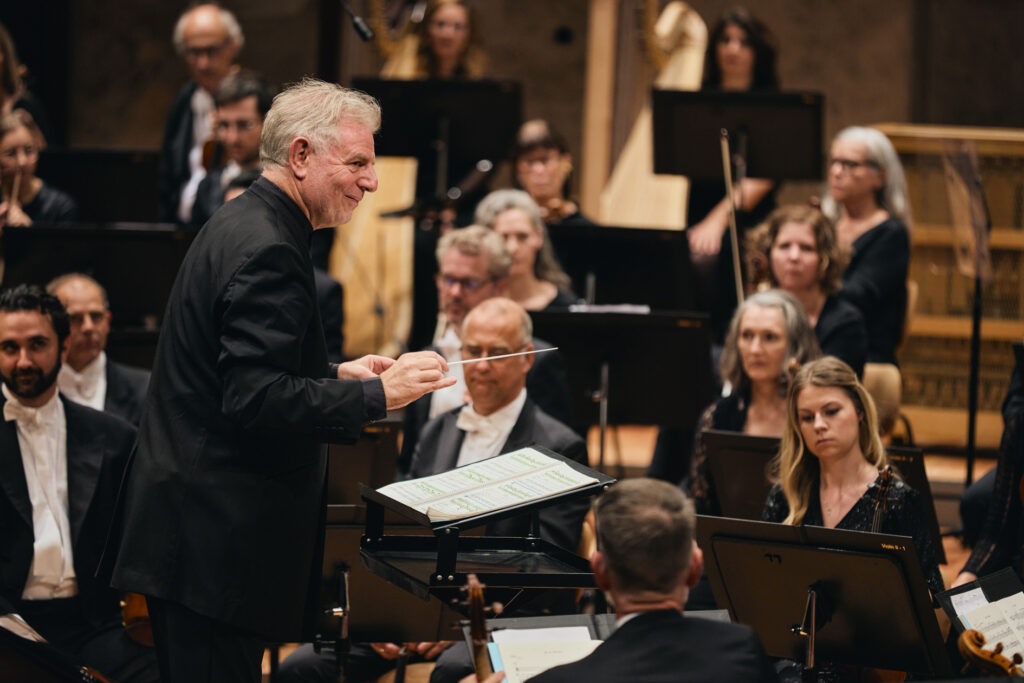
Reconstructing the opera’s surviving musical material has obviously been a labour of love for musicologist Kai Hinrich Müller and Karl-Heinz Steffens, Norrköping’s conductor. What could have been an amusing resurrection of a lost work unfortunately ended up as a lost opportunity. The wordy English text was practically incomprehensible as delivered by a mostly non-Anglophone cast. They were not helped by a brass-heavy orchestration that often doubled the vocal line, swamping their light, lyric voices. It’s hard to know who to blame for ignoring this rudimentary rule, Blitzstein, or his two contemporary champions.
Of the soloists, American tenor Matthew Newlin fared best in the sonic battle. But even his clear tone and idiomatic enunciation tended to get swamped. This was surprising for a singer who takes on roles like Don José at Deutsche Oper Berlin, again making one wonder if it was the orchestration that was to blame.
The opera was presented in strict concert form with hardly any interaction between the singers. The score contains very little conveyance of character through the vocal line. Other than its ties to one of the great schools of modern design, it’s difficult to see a future for this rarity.
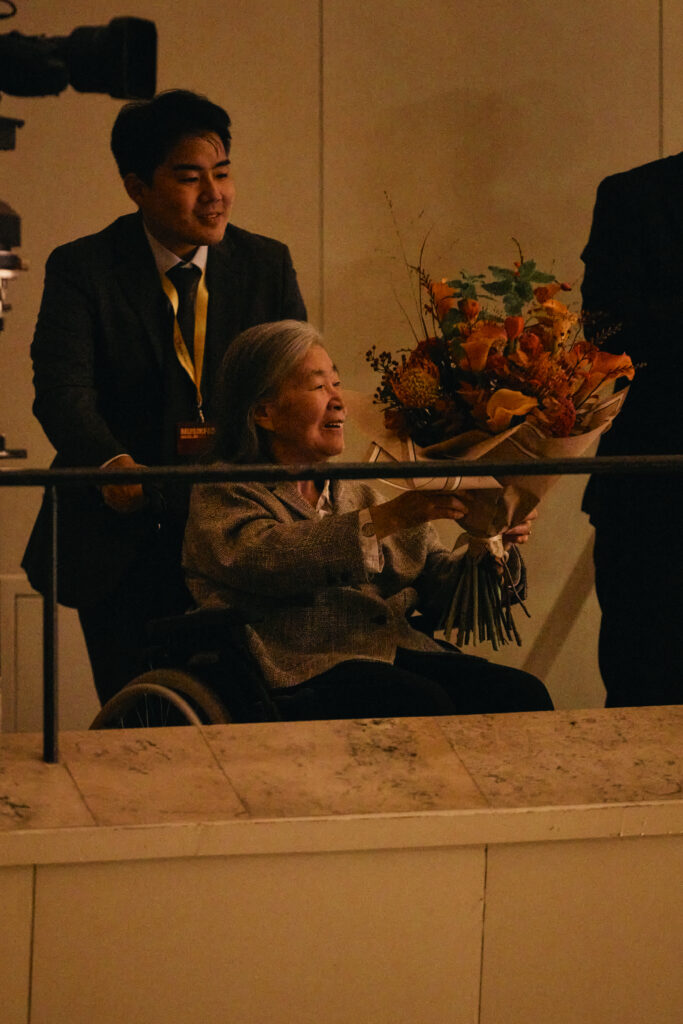
Closing out Musikfest Berlin’s four packed weeks was South Korea’s Busan Philharmonic Orchestra. Their Sept. 23 program managed to tie together all of the festival’s foci with new, newish, and really-not-that-old works. They celebrated the 80th birthday of the Korean composer Younghi Pagh-Paan who was present to receive heartfelt tributes. Her 1980 work, Sori, was written in response to a student uprising against Korea’s military dictatorship resulting in the massacre of 2000 people.
It is influenced by Korean folk music including the now almost-extinct practice of “nong-ak” which involves prayer, thanksgiving and the driving out of evil spirits with the aid of percussion and wind instruments, dance and acrobatics. Indeed the percussionists were busy with all manner of hanging bamboo reeds and dried peas in a bongo drum, in addition to their more traditional instruments. This was an extremely powerful, chaotic, pain-laden work that packed an emotional punch.
Pagh-Paan’s “Frau, warum weinst Du? Wen suchst Du?” (2023) is inspired by the Biblical text spoken by Jesus to Mary Magdalen after his resurrection. More lyrical than Sori, this consoling, string-based work shows a softer aspect of her style.
American pianist Ben Kim joined the orchestra for Ravel’s Piano Concerto for the Left Hand in D major (1930) offering dazzling pianism and charisma. Perhaps the orchestra’s artistic director Seokwon Hong unleashed his forces a little too enthusiastically at times, covering Kim, but overall, this was a bracing, properly acidic traversal of an early modern masterpiece.
Messiaen’s L’Ascension—Quatre méditations symphoniques (The ascension—Four Symphonic Meditations) (1933) opened the second half. This ecstatic, triumphant work really defines the raison d’être of the festival to present fringe works by 20th-century masters that you’re unlikely to hear anywhere else. Its four movements run the gamut from trumpet fanfares to string threnodies that capture the French composer’s intense religiosity and mysticism. The last section makes brutal demands of the strings in their highest register, well-delivered by the Busan forces.
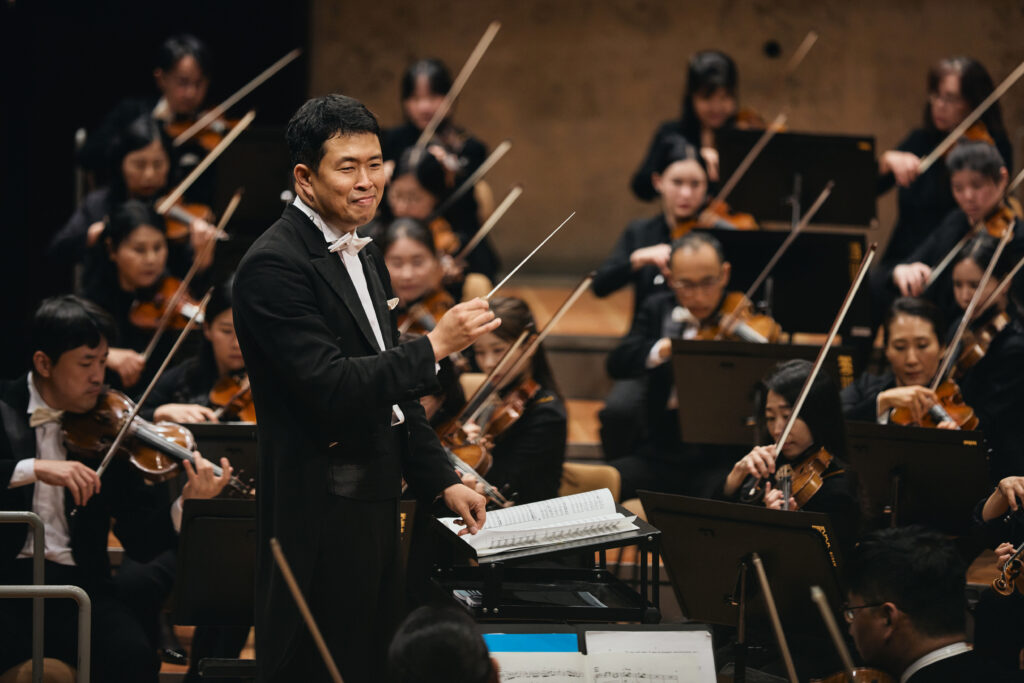
The concert, and Muskifest Berlin for that matter, were brought to a thrilling close with Sibelius’s Symphony No. 7 in C major, (1924). Its single movement structure relentlessly unfolds in a manner that encapsulates the contemporaneous unfurling of the 19th into the 20th-centuries. The obvious love of the score communicated by conductor Hong, and between the players themselves, ensured the music-making ended on an emotional high note.
When Musikfest Berlin closed its 21st edition on Sept 23, it had presented 33 concerts featuring 122 works by some 70 composers, performed by 27 instrumental and vocal ensembles from Berlin, Frankfurt, Munich, Paris, London, Rome, Odessa, Sweden and South Korea along with 45 soloists from Berlin and around the world. Audience attendance was an impressive 49,000. The 22nd edition will take place from Aug. 28 to Sept. 23, 2026.
Click here for more on Musikfest Berlin.