Musikfest Berlin has to be one of the premiere orchestra extravaganzas in the Western classical music world. Every year, in late summer, many of the world’s leading large instrumental ensembles, star conductors, renowned soloists and choirs gather in Berlin for a grand kick-off to the new season. Most of the concerts take place at Philharmonie Berlin, the city’s acoustically-blessed hall, opened in 1963 on what were then the far eastern edges of West Berlin.
The selection of repertoire goes well beyond a random walk-through of greatest hits, but is instead curated around several carefully-selected themes. This year those include a focus on Paris, and celebrations of the 100th birthdays of two 20th-century giants, French composer and conductor Pierre Boulez’s and his Italian fellow composer and friend, Luciano Berio. The latter celebrations also point to one of the central tenets of Musikfest Berlin to present the music of our times.

Berio was chosen to open the festival on Aug. 30 with his Rendering (1989), based on the few sketches Franz Schubert made for his Symphony No. 10, completed here with music derived from other Schubert works. Musikfest couldn’t have landed a bigger name to kick things off than Finnish conductor Klaus Mäkelä who arrived with Amsterdam’s Royal Concertgebouw Orchestra. The 29-year-old will become the fabled Dutch orchestra’s music director in 2027 at the same time he takes up the same post at the Chicago Symphony Orchestra. This is in addition to his current leadership roles at Oslo Philharmonic and Orchestre de Paris (it was recently announced he’ll leave the latter in 2027). Much has been written about Mäkelä skipping the usual conductor trajectory of starting at smaller orchestras as did many of his celebrated predecessors like von Karajan, Furtwängler, Reiner, Klemperer and Solti. The jury is still out on what the effect might be on these great ensembles of Mäkelä jumping between multiple major assignments.
In any case, the artistic results were solid on Aug. 30. Both the Berio, and the other work on the program, Bartók’s Concerto for Orchestra (1943) are fragmentary by nature, so Mäkelä wasn’t really required to demonstrate much of an overarching musical plan in either case. Rendering alternates between noble brass melodies and characteristic Berio slippery tonal disintegration initiated in the strings. In the sections more tied to Schubert’s sketches, the Concertgebouw strings demonstrated a homogeneous, rich smoothness that would be hard to beat. The orchestra immediately established an appropriately foreboding mood at the beginning of the Bartók with its “night music,” initiated by creeping, low strings reminiscent of the opening of his opera, Bluebeard’s Castle.

The next night, on Aug. 31, Musikfest presented two other Dutch groups: the Netherlands Radio Philharmonic Orchestra and the Netherlands Radio Choir under the direction of Chief Conductor Karina Canellakis. They introduced one of the festival’s other anniversary celebrants with Boulez’s Le soleil des eaux (1948/65), a work for soprano, choir and orchestra that sets two poems by the French writer René Char. The first, the love-song of a lizard to a goldfinch, saw American soprano Liv Redpath offer radiant, carrying tone delivered with an exterior calmness and appropriate French objectivity.
The excellent chorus joined Redpath for the second song and then were the main feature in Dutch composer Robin de Raaff’s new cantata for choir and orchestra L’Azur (2025) based on the poem of that name by Stéphane Mallarmé. Full of robust outbursts until ending in choral whispers, it would have helped the audience to appreciate the work had the text been projected on the screens already in place.
American conductor Canellakis used big, angular gestures to good effect in the program-closing Symphonic Dances op. 45 (1940) by Sergei Rachmaninoff. She coaxed great attack in the opening movement’s famous three-note theme, and authentic give-and-take in its waltz rhythms. The middle movement’s acidity, more in the mode of Shostakovich than is our typical view of uber-romantic Rachmaninoff, was offered with appropriate bite.

The appearance of Orchestre de Paris on Sept. 1 had unintended significance. One wonders if the evident smiling between players had something to do with the fact that their conductor for that night, Finnish maestro Esa-Pekka Salonen, was announced the next day as their new leader. He will succeed his compatriot Klaus Mäkelä for a five-year term in Sept. 2027.
The Parisian forces took us back to Berio with his Requies (1983/84), created in memory of American singer and composer Cathy Berberian, his wife of 14 years and also, longstanding artistic partner. Musikfest recently interviewed the couple’s daughter Cristina Berio, about the important role her mother played in co-creating Berio’s works. Scored for smaller, chamber forces, the orchestra highlighted the work’s subtle, diaphanous textures in which xylophone and harp feature prominently.
Next, Salonen conducted his own new Concerto for horn and orchestra (2025) with Berlin Philharmonic principal horn Stefan Dohr as soloist. The piece makes all kinds of virtuosic demands ranging from Dohr blowing air through his instrument without producing a pitched sound to incredibly demanding melismatic passages to cap off the final movement. The orchestra’s percussion also got a thorough workout, especially in the finale’s syncopated sections.
Salonen has no doubt conducted and recorded Sibelius’ Symphony No. 5 in E-flat major (1915–19) more times than most artists can boast. This resulted in what will no doubt be one of this year’s festival highlights. The synchronicity of players and leader was palpable from the start as Salonen coaxed his thoughtfully-planned take with the musicians’ full complicity. The pizzicati that open the second movement were perfectly chamber-like—you could see the players checking in with each other, nodding and mutually approving. Some of the work’s big themes were taken quite slowly, but Salonen knows exactly how to immediately make up for lost time to produce a satisfyingly-balanced interpretation. As an encore, we finally got some ur-French music from these Parisian forces with “Le jardin féerique,” the concluding movement of Ravel’s Ma mère l’oye suite, with its ecstatic harp solo. The audience went wild.
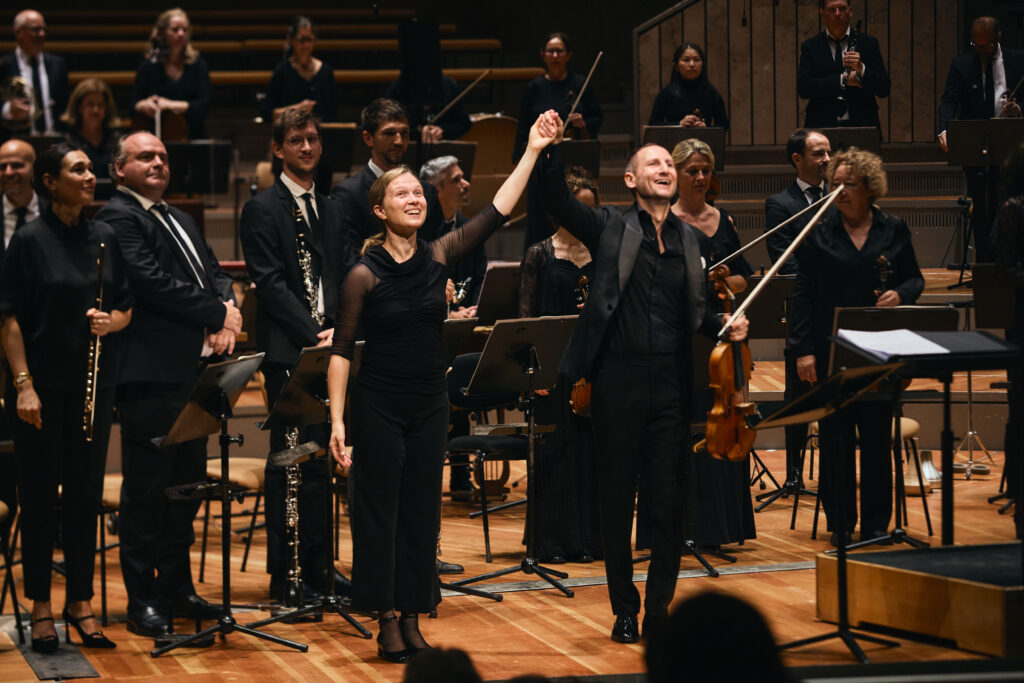
Another French orchestra took the Philharmonie stage on Sept. 2. Under conductor Mirga Gražinytė-Tyla, Orchestre Philharmonique de Radio France circled back to Berio, unearthed a Lithuanian rarity, and gave a thrilling account of a French repertoire staple.
French violist Antoine Tamestit, who plays on the very first viola made by Antonio Stradivarius in 1672, joined the orchestra for Berio’s Voci (Folk Songs II) (1984). The ensemble was divided into two sections, one on the level of the conductor and soloist, the other on a raised platform. Berio’s transcriptions of Sicilian folk songs sometimes emerged fully-formed, and at others, as fragments. Tamestit sensitively conveyed their character, extracting full rich tone from his instrument when required, or even, making it sound like a mandolin against a sparse bongo drum accompaniment.
A proponent of music from her native Lithuania, Gražinytė-Tyla programmed late romantic composer Mikalojus Konstantinas Čiurlionis’ vivid depiction of the sea in Jūra (1903-07). This was program music on a huge scale, with prominent use of the hall’s organ. The composer exploits the colours of solo instruments like the bass clarinet, oboe and even the unusual combination of violin and organ to describe the moods of the sea. Perhaps erring a bit on the side of bluster and literalism, it was nevertheless fascinating to hear this Strauss-adjacent tone poem.
The Radio France forces closed their program with Ravel’s Boléro (1928). This was a bracing, fierce interpretation that confirmed how clarifying it can be to hear an orchestra play music from its native repertoire. There was a leanness to the string playing, and an unsentimental, forward-moving drive that provided the excitement necessary to elevate such a well-known repertoire staple.
Another focus of the 2025 festival is German composer Helmut Lachenmann to mark the 90th birthday of the grandmaster of musique concrète instrumentale. This style of contemporary classical music relies heavily upon unconventional playing techniques to produce noisy, airy, or otherwise unpitched sounds. These effects can be achieved by applying heavy bow pressure to a string instrument to make a scratch tone for example, or by blowing air directly through a wind instrument without producing a sounding note.
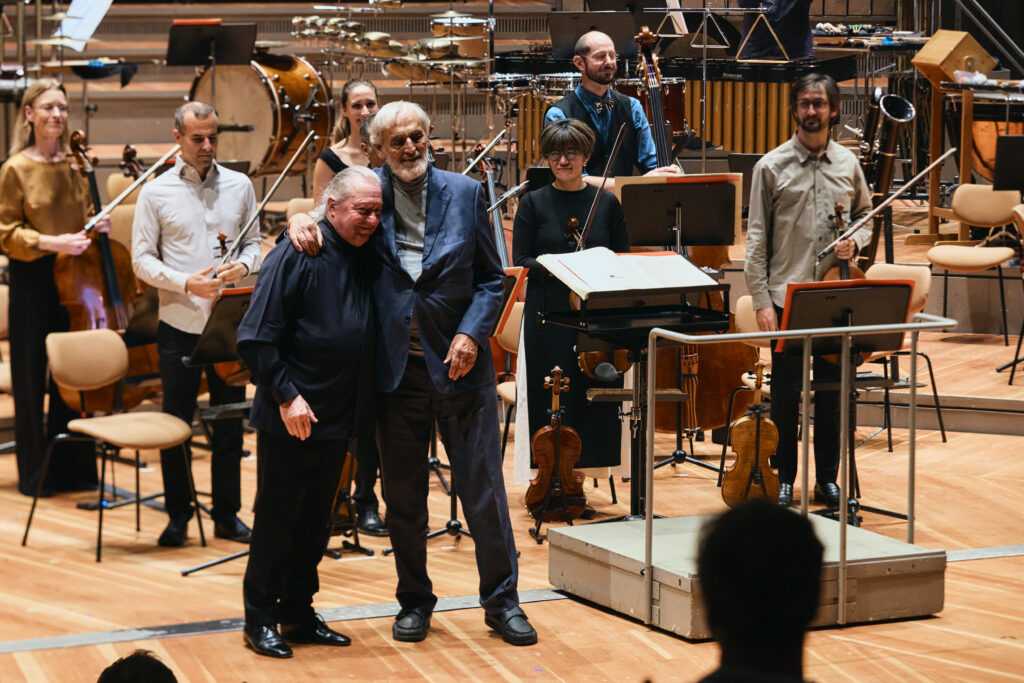
For their Sept. 3 concert, Berlin’s Ensemble Modern performed Lachenmann’s Concertini (2005) with an intergenerational ensemble that included scholarship holders from their International Ensemble Modern Academy. With musicians placed in the far reaches of the hall, the ensemble offered an all-encompassing, aurally-challenging experience. The composer was feted onstage following the performance.
On Sept. 4, the Deutsches Symphonie-Orchester Berlin under Anja Bihlmaier presented a carefully-curated program of works that directly, and perhaps more subtly, satirize power structures. Inspired by Alfred Jarry’s play Ubu roi, Bernd Alois Zimmermann’s ballet Musique pour les soupers du Roi Ubu (1968) unashamedly draws on disparate periods and styles of music ranging from Bach to the Radetzky March. A mishmash of non-traditional instrumentalists including a jazz combo and electric guitars enthusiastically launched into recognizable canonical bits like Wagner’s Ride of the Valkyries and his Siegfried Idyll. The parody of Shakespeare’s Macbeth and parts of Hamlet and King Lear in Jarry’s play found a worthy musical equivalent in Zimmermann’s eclecticism.

Although Shostakovich’s Symphony No. 9 (1945) was originally intended to be a celebration of the Soviet victory over Nazi Germany in World War II, Soviet critics censured the symphony for its “ideological weakness.” Indeed, its light, bouncy opening movement and mocking march in the final section reveal the composer’s true feelings about the regime he was meant to glorify. Bihlmaier’s dance-like movements on the podium were entirely apropos given the material, with two of the cellists particularly inspired to channel the rhythms she inspired.
On a totally different note from the Zimmermann and Shostakovich, the orchestra opened their program with what for me was another of the opening week’s highlights, Tchaikovsky’s Variations on a Rococo Theme (1877) with cellist Kian Soltani as soloist. This was a prime example of the ability of an inspired soloist to elevate what many might dismiss as an orchestral bon bon. Soltani’s virtuosity, his ability to access all the colours and dynamic ranges of his instrument, and emotional investment were extremely affecting. He was able to turn fast track staccati into filigree legato on a dime. His encore, Tchaikovsky’s Nocturne for Cello and Orchestra, confirmed his ability to emotionally connect with his audience.
Stay tuned for more from Musikfest Berlin which continues through Sept. 23. Full programming details can be found here.