
This page is also available in / Cette page est également disponible en:
 Français (French)
Nothing seems to be able to stop Angine de Poitrine’s rise to fame. The Quebec band of the moment—whose song Fabienk reached No. 1 worldwide on Spotify in April 2026—took a while to break through, but this time they’re really off to the races!
Contrary to what many fans would like to believe, Khn and Klek—the stage names adopted by the two masked accomplices—are not aliens. They were not born on a planet covered in black or white spots, beyond the boundaries of our solar system. Both hailing from La Baie, these artists—on guitar, vocals and drums—have managed to carve out a niche for themselves in Saguenay region circles, which are at times institutional and at other times openly anti-institutional.
Between 2013 and 2023, before forming Angine de Poitrine, they could be found playing their music in punk venues as well as on the no less alternative stage of the Centre d’expérimentation musicale (CEM) in Chicoutimi. It was there, in the studios of this organization which supports artists in the field of experimental music, that the duo recorded their first two albums in 2016 as related by the organization’s general and artistic director, Guillaume Thibert, in an interview with Le Devoir.
In return for that opportunity, the two performers have subsequently taken part, both as members of larger ensembles and as soloists, in premiere performances of works by various CEM composers-in-residence. Among their mentors is René Lussier, a self-taught guitarist who defies categorization, operating at the crossroads of jazz, contemporary music and noise music.
Imagine performance settings similar to the composition workshops organized by the Société de musique contemporaine du Québec, Oktoecho, the Nouvel Ensemble Moderne, or the sort of events featured at the Festival international de musique actuelle de Victoriaville. This work is at the heart of a serious artistic endeavour— supported by musical notation, if not by improvised musical forms.

Some 10 years have passed between the formation of the original band and Angine de Poitrine, a period during which Khn and Klek absorbed a wealth of knowledge, influences and styles to arrive at an expression of fully informed modernity. The development of their visual identity, now ubiquitous across the internet, and the content of their publications demonstrate a profound understanding of the avant-garde movements of the 20th century. Clearly, the musicians have embraced concepts such as subversive art and a return to geometric forms, elevated to the status of symbols, which are undoubtedly part of the modernist lexicon.
They are also known for their penchant for short, enigmatic track titles. With the release of the album Vol. 1 in 2024, the duo took this approach to its logical conclusion by using only consonants and rudimentary syllables, in keeping with the Dadaist tradition to which they subscribe.
The fact that they employ a whole range of descriptors such as “Mantra rock” and “Dada” to characterize their creative process is reminiscent, on a smaller scale, of the use of manifestos in the history of modern art (Dadaism, Futurism, Surrealism—every artistic movement has published a founding text to ensure its longevity). In 20th-century music, the composer’s written elaboration of ideas and the textual explanation sometimes count as much, if not more, than the resulting sound. Angine de Poitrine is not far from falling into the same excess.
Another term worthy of attention is “Pythagorean-Cubist,” a clear reference to the angular forms mentioned earlier that have shaped abstract art. In this context, the triangle is a key symbol. It adorns the musicians’ costumes and has also become a rallying sign, as if it were a new collective ritual. People join their hands with their index fingers and thumbs in all sorts of contexts, whether in communion with Khn and Klek or on social media through subliminal emojis.
The Pythagorean universe, adorned with perfectly circular black and white dots, is also evident in the music. In an interview with nousTV Saint-Hyacinthe in October 2024, the drummer described the style of their previous band as “math punk.” It is clear that irregularity of the metre—numerous shifts from 7/8 to 2/4 and back to 7/8—complexity of the rhythms, which are difficult to notate, and abrupt silences remain part of their trademark sound.
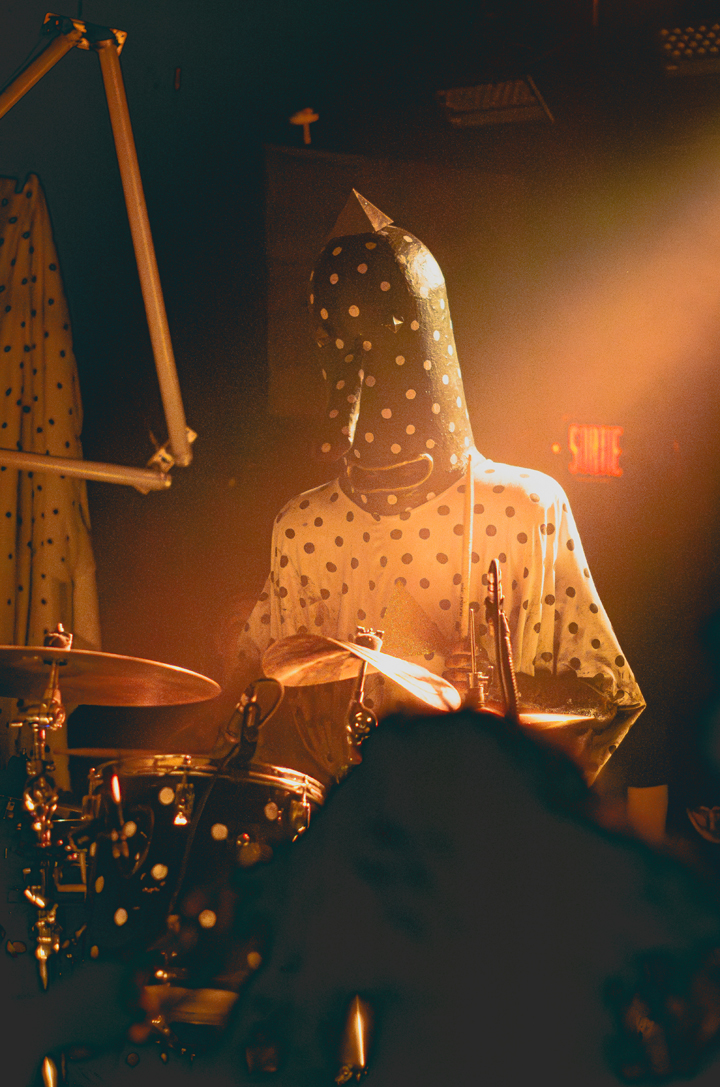
In contrast, the vocal technique the guitarists once used has now been all but abandoned. This piercing voice, known as a scream or harsh vocal in punk slang, has been replaced by guttural sounds, used to address the crowd, and filtered vocal interjections in songs such as Fabienk and Mata Zyklek. With such an extraordinary range of techniques, Khn and Klek could easily pass for aliens!
As for new features, there are of course the costumes, masks and phallic-shaped noses, but also, and above all, microtonal guitar and bass fused into a single instrument. This allows the Poitrine brothers to explore new sonic horizons, such as the scales of traditional Indian music. Their approach to performance, including an electronic looping module operated by the guitarist’s foot, is no less sophisticated than the one they used in the past at CEM.
Research and fact-checking of information done for this piece, particularly drawing on the Le Devoir interview mentioned earlier, respects the artists’ request for anonymity. For more information on the band’s tour dates and music, visit www.anginedepoitrine.com
Translation: L. I. Liganor
This page is also available in / Cette page est également disponible en:
Français (French)