This page is also available in / Cette page est également disponible en:
 Français (French)
Often, chance works in mysterious ways. That’s how a glance at a painting by Ferdos Maleki in a Magog art gallery transported double bassist Ali Kian Yazdanfar to that artist’s studio in San Diego. It is another Maleki painting, Gratitude III, that graces the cover of the bassist’s new album, Sayeh-Roshan, released this month on the Leaf Music label.
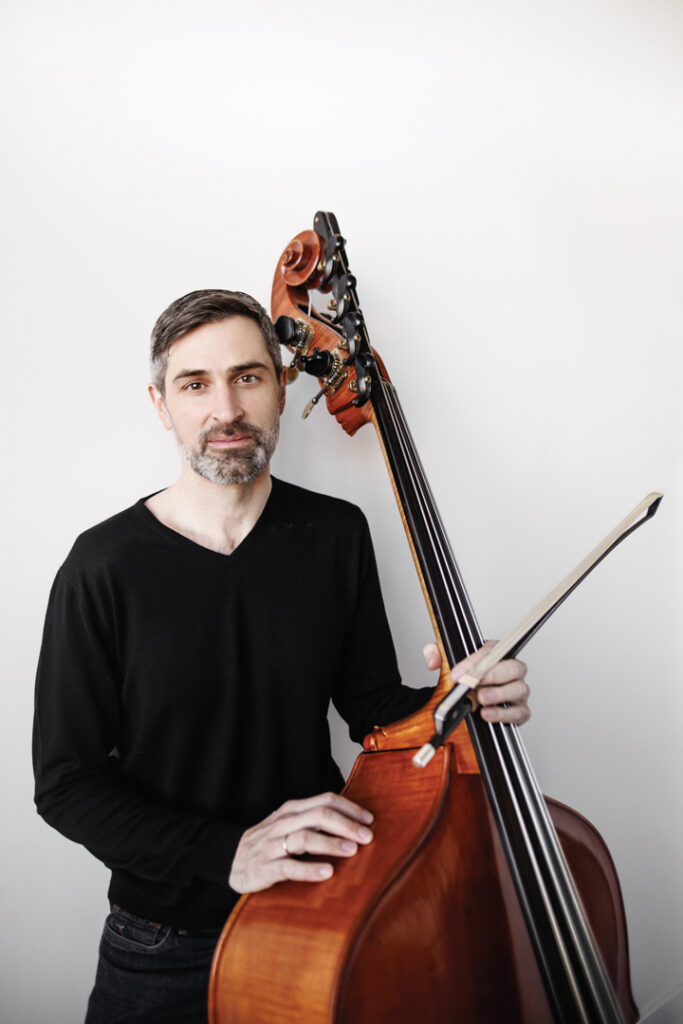
Like this painting, the album conceals unforgettable encounters and exchanges across its 18 tracks, the fruit of several years of work that has finally materialized. “Several desires are at the origin of the album: to show another side of the double bass, to define myself through the proposed repertoire, and finally to offer a reflection on the multiplicity of cultures,” says Yazdanfar. As principal double bassist of Orchestre symphonique de Montréal, he has never stopped seeking to bring the Iranian musical tradition into harmony with the reality of his daily life in Quebec. “The double bass is often misunderstood as a solo instrument, but in an intimate setting, it has a specific voice that makes the body vibrate.” Thus, with the pandemic as a catalyst, Yazdanfar began a series of commissions for works for double bass and piano. He had decisive encounters with composers Reza Vali, Parisa Sabet, and Amir Eslami. In addition to these commissions, he incorporated a traditional Iranian music duet with the kamancheh (a high-pitched stringed instrument) and the tombak (a traditional drum) into the album’s program.
The entire recording is structured around the idea of chiaroscuro, of balance between tradition and modernity, East and West, between the low notes of the double bass and the high notes of the kamancheh. Thus, traditional music rubs shoulders with new repertoire in a unity and coherence that reflects the reality of a large part of Canada’s population with its diverse origins. “The album has a unifying character for the Iranian community, but also beyond,” says Yazdanfar. “In the many concerts that preceded the album’s release, I had the opportunity to often talk with the audience, and I find these moments very enriching. This music makes us reflect on the very idea of belonging.”
This is how differences fade away, giving way to a musical continuum that is both fluid and complex, light and dense. The modes and playing techniques of the contemporary repertoire are not so unusual once you realize that traditional music is naturally full of them. “In traditional music, we do everything with instruments. This stems from the artists’ need to be able to express themselves as they wish. By removing barriers, we can ultimately do anything with an instrument,” Yazdanfar explains. “There are certain techniques that I don’t like as much, so I naturally avoid them, and others that suit me well.”
A true bridge between cultures, Sayeh-Roshan manages to express in music a complex and subtle reality that is too often masked by the simplistic or black-and-white discourse that resonates around us. Much more than an album, it is a way of understanding difference with serenity, kindness, and openness.
Translation: L. I. Liganor
This page is also available in / Cette page est également disponible en:
Français (French)