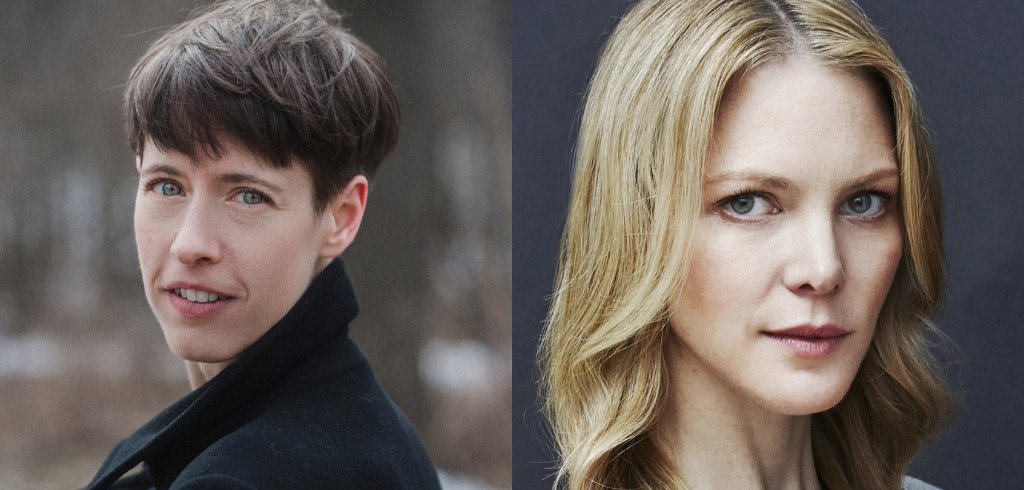

What might the end of our human days look like? What might happen if we reach a solar minimum? These are questions posed by composer Cecilia Livingston and librettist Duncan McFarlane’s Parḗlios, a work that sits somewhere between opera, oratorio, dance, and installation.
The piece, which premieres on June 12 as part of Opera 5’s Toronto Opera Festival, “imagines a population in an imaginary Britain that is losing the sun.” Will those people end up staring at a semicircular screen, a ceiling of mirrors, artificial mist, and aluminum frames to experience an illusion of the sun? This possibility was suggested to Livingston and McFarlane by Olafur Eliasson’s 2003 art installation, The weather project, which they saw at London’s Tate Modern. Or will people migrate somewhere they hope might be warmer—that will sustain life?
The opera’s loosely-defined characters, of wind and wanderers, are “really beautifully embodied and drawn out of the text through the three dancers (Sully Malaeb Proulx, Jarrett Siddall, and Miyeko Ferguson) that are a part of the production,” says Livingston. Director, choreographer and dancer Jennifer Nichols will stage the premiere. “The way Jennifer reads the text and hears the music and sees these opportunities for movement to illuminate things like rhythm, motifs, but also the sound and meaning of the text, is really striking to me,” Livingston adds.
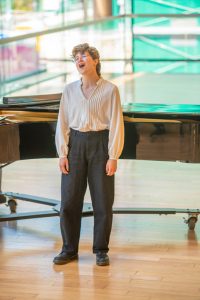
Parḗlios’s sound world involves choir, four soloists—Len Crino, Brenden Lengsfeld, Ryan Nauta, and Aaron Dimoff—and percussion. “I think people are really going to be struck, from the musical side of things, about the sound world,” says Music Director Evan Mitchell. “An operatic sound world brought about solely by percussive sounds—without strings, winds or brass, but with the emotional arc of vocal lines—is unfamiliar.”
Livingston began working on Parḗlios back in 2016, as a collaboration with TorQ Percussion Quartet. She knew the ensemble from the University of Toronto, and was fascinated by “the incredible physicality of their performances.” The theatricality of percussion performance was an inception point for Livingston’s composition.
In terms of how percussion relates to opera, audiences might think more in terms of drums and unpitched percussion. But with Parḗlios, the core of the piece is mallet and keyboard percussion. “It’s harmonic and melodic in the way that we might expect opera to be. It’s just a completely different palette of timbres,” says Livingston. Parḗlios’s musical language encapsulates everything from minimalism to Radiohead, with the composer imbuing both voice and percussion with a core of melody as well as the structural play of canonic forms.
McFarlane and Livingston have worked together since 2013 on countless art song, opera, and oratorio projects. “His writing is really complex. It’s full of allusions. The sounds in the text are just gift after gift for a composer,” says Livingston. This project marks a full-circle moment for the writing team, as their first work together was a 2013 chamber opera for Opera 5—The Masque of the Red Death—as part of a triptych of operas based on Edgar Allan Poe stories.
“There’s just so much joy in working with that team,” Livingston says. “Their music director, Evan Mitchell, really seems to look at my scores and get what it is that I’m trying to do, which is just so extraordinary.”
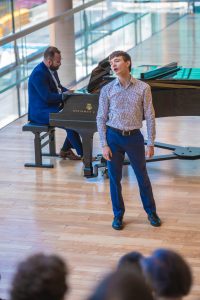
Livingston is also enthused about Opera 5’s portfolio artist internship program, and “that there are early-career artists who are excited about new work, who want to learn more about that process, and who are bold about that.”
Soloists Crino and Lengsfeld, as well as members of the chorus, are among this year’s interns. In the rehearsal room, Livingston is eager to invite artists to ask questions, make suggestions, and really be a part of the process. “I hope that means that if it’s a first experience with new work, that it’s a really happy thing and that it fosters a sense of agency,” she says.
In dialogue with the other two operas being presented at the festival—Puccini’s Gianni Schicchi and Suor Angelica—Livingston notes connecting threads, referring to Parḗlios as a “kind of lament for humanity’s end.” She also relates the works through a melodic tonal core.
At a fundamental level, however, Livingston says that all three works do what opera does best, which is to “invite us to sit down together in the dark and think about complicated, challenging things, which we’ve been doing now for thousands of years.” She hopes that Parḗlios creates an opportunity for audiences to connect and reflect, as they bring their own sets of memories, emotions, thoughts, worries, and ideas.
“You only get to hear something for the first time once,” says Mitchell. “It’s going to be this unique experience that can only be achieved with the world premiere of a piece of this nature, and that’s extremely exciting.”
Opera 5’s Parḗlios runs June 12–14 at Theatre Passe Muraille. www.opera5.ca; www.cecilialivingston.com